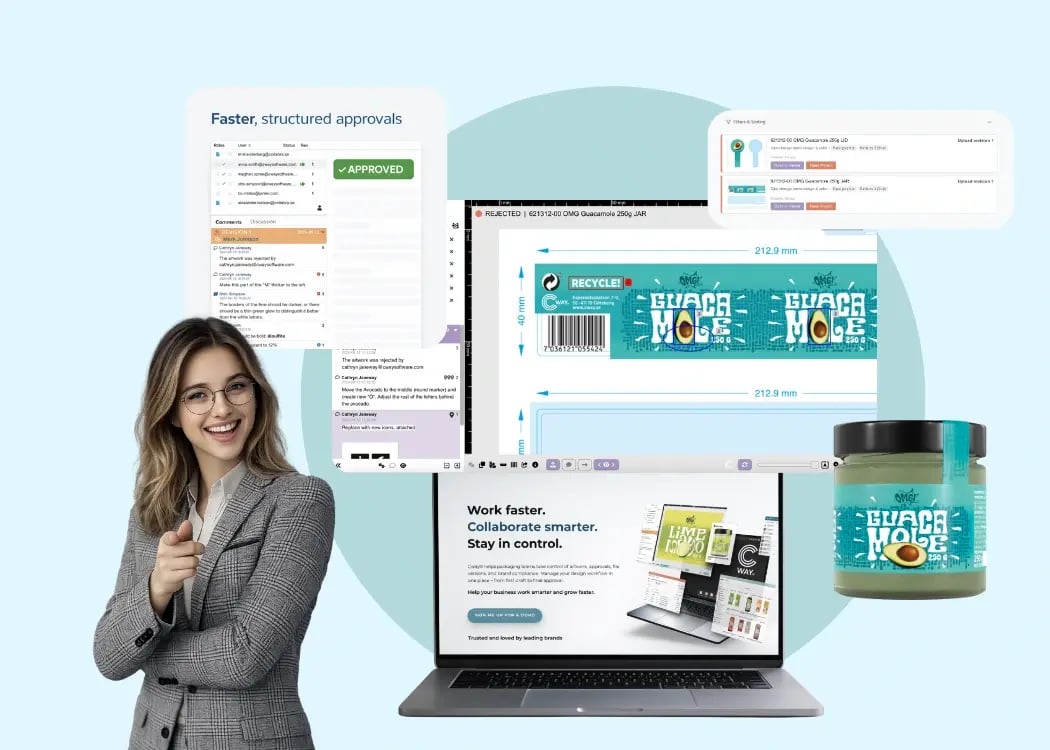

Cway vs BLUE Software:
Artwork Management Comparison (2026)
BLUE Software is the right choice for pharmaceutical and life sciences companies with strict GxP and FDA compliance requirements.
For CPG, FMCG, Food & Beverage, and Beauty brands, it is typically over-engineered, over-priced, and slow to implement. Cway is purpose-built for packaging teams in those industries: SaaS deployment in 2–4 weeks, transparent pricing, and a full artwork lifecycle from brief to print-ready file — without the complexity of a pharma-grade compliance platform.
For growing brands, this often translates into faster time-to-market, easier team adoption, and significantly lower total cost of ownership. In practice, teams can standardize workflows and scale packaging operations without needing dedicated IT or heavy system configuration.
Who This Comparison Is For
This page is for:
- Packaging & brand managers looking to streamline workflows and reduce bottlenecks
- Regulatory & compliance teams ensuring labeling accuracy and audit readiness
- Operations & supply chain leaders focused on speed-to-market and execution
- Teams currently using BLUE Software wondering if a faster, more accessible alternative exists
- Buyers in CPG, Food & Beverage, Beauty, or Retail assessing their options for 2026
TL;DR
Both Cway and BLUE Software manage the full packaging artwork lifecycle — briefing, approvals, version control, supplier handoffs, and compliance. The difference is scale, speed, and cost.
BLUE Software is an enterprise LAM platform with per-feature annual pricing starting at €7,500/year and implementation cycles suited to large organisations with IT resources.
Cway is a modular SaaS platform with transparent monthly pricing from €450/month, 2–4 week onboarding, and an interface built for brand teams, not IT departments. For mid-market CPG and FMCG teams, Cway delivers comparable core functionality at a fraction of the cost and time to value.
This comparison is built around the question packaging teams most often ask: which platform was built for the problem we are actually trying to solve — and can we get there without a six-month project?
Cway vs BLUE Software: Feature-by-Feature Comparison
This table covers the criteria that matter most for packaging artwork teams. We have been as honest as we can be — including where BLUE Software is stronger.
| Feature / Criteria | Cway | Blue |
|---|---|---|
| Primary industry focus | CPG / FMCG (consumer brands); Packaging-heavy industries with high SKU volume Typical industries:
|
CPG (especially branded goods) + regulated industries Typical industries:
|
| Core focus | End-to-end packaging workflow & operations | Label & artwork management with compliance focus |
| Workflow management |
Strong, flexible workflow automation with task ownership and real-time tracking | Workflow templates with collaboration across stakeholders |
| Full artwork lifecycle | ✅ Brief → print-ready |
✅ Full lifecycle |
| Artwork management | ✅ Centralized artwork, projects, and version control in one system | ✅ Centralized label & artwork lifecycle management platform |
| Online proofing & annotation |
✅ Built-in |
✅ Built-in |
| Version control | ✅ Automatic, packaging-aware | ✅ Full version tracking |
| Full audit trail | ✅ End-to-end | ✅ Available |
| Digital asset management (DAM) |
✅ Built-in, Artwork-focused | ✅ Includes asset libraries and content management |
| Analytics & reporting | Workflow analytics, bottleneck detection, performance insights | KPI improvements (e.g., speed-to-market, accuracy), but less ops-focused analytics |
| Collaboration | Strong collaboration with agencies, suppliers, and teams | Collaboration across marketing, regulatory, and supply chain |
| Operational visibility | High (dashboards, real-time tracking, workload visibility) | Moderate (focus more on process execution than ops visibility) |
| Regulatory / labeling strength |
Present but not primary differentiator | Core strength (label accuracy, compliance-heavy workflows) |
| Speed-to-market optimization | Core value proposition (faster approvals, fewer delays) | Also improves speed, but balanced with compliance |
| Ease of use | ✅ High — built for brand teams | ⚠️ Complex — training required |
| Pricing transparency | ✅ Published on website | ❌ Enterprise sales process |
| Pricing model | Modular SaaS — Starter, Pro, Enterprise | Per feature, per year |
| Entry price | From €450/month | From €7,500 / feature |
| Free trial / demo | ✅ Demo available/Free trial per request | ❌ No free trial |
Key Takeaway
- Cway → stronger in workflow orchestration, visibility, and speed
- BLUE Software → stronger in labeling accuracy, compliance, and structured control
In simple terms:
- Cway = “run packaging like an operation”
- BLUE = “control packaging like a regulated process”
Key Differences Explained
1. Pricing Model
This is the sharpest difference. BLUE Software charges per feature, per year — starting at €7,500/feature/year, with no free trial. For a mid-market CPG brand that needs four or five core LAM features, the annual licensing cost alone can be significant before implementation fees are added.
Cway starts at €450/month with modular plans that include the supplier portal, compliance fields, multi-market management, and audit trail as standard. Pricing is on the website. You can book a demo without going through enterprise sales.
2. Implementation Time
Cway onboarding takes 2–4 weeks. The Cway team handles configuration, user setup, and workflow mapping as part of the standard package. Most teams are running live projects within the first month.
BLUE Software requires a structured enterprise implementation. The timeline depends on scope — number of users, integrations, and workflow complexity — and typically extends over multiple months for a full deployment at enterprise scale.
3. Esko Ecosystem Fit
If your organisation already uses Esko tools — WebCenter, ArtiosCAD, Studio, or Automation Engine — BLUE Software integrates natively into that environment. That is a genuine and significant advantage. It is one of the strongest reasons to choose BLUE over Cway when you are inside an Esko-heavy stack.
Cway connects to external systems via open API but is not part of the Esko ecosystem. If Esko integration is a hard requirement from your prepress or IT team, Cway may not be the right fit.
4. Ease of Use
Cway is designed for the people who actually do packaging work — brand managers, packaging coordinators, artwork teams. The interface follows the packaging workflow without requiring IT configuration or specialist training for day-to-day use.
BLUE Software is a powerful platform, and power comes with complexity. Users typically need training to work effectively in the system, and the IT team plays an ongoing role in administration and configuration at enterprise scale.
5. Supplier Collaboration
Cway includes a dedicated supplier and printer portal across all plans, at no extra cost. External partners get structured access to exactly the files they need, with permissions controlled by the brand team — no user account required for external reviewers.
BLUE Software supports external collaboration, but access follows the enterprise user model, which typically requires managed accounts for external stakeholders.
Choose Cway Software if
-
You are a mid-market CPG, FMCG, Food & Bev, or Beauty brand
-
You need to be live in weeks, not months
-
You want transparent, predictable SaaS pricing
-
You work with external suppliers, agencies, or printers who need structured access
-
You handle multiple SKUs, markets, or language variants simultaneously
-
Your team does not have dedicated IT resources for implementation
-
You are replacing email approvals, shared drives, or spreadsheet tracking
Choose BLUE Software if
-
Your organisation is already inside the Esko ecosystem (WebCenter, ArtiosCAD, Studio)
-
You manage a very large SKU portfolio requiring deep enterprise feature sets
-
You have IT resources and a structured implementation process
-
You need native integration between artwork management and prepress or structural design tools
-
Your organisation operates across life sciences with specific LAM compliance workflows
Pricing Comparison
Here’s a realistic price comparison between Cway and BLUE Software — based on available public data and how these platforms are typically sold.
|
|
Cway |
Blue |
|
Pricing model |
Modular pricing model with three package levels — Starter, Pro, and Enterprise |
Per feature, per year |
|
Entry cost |
From €450 / month |
From €7,500 / feature / year |
|
Pricing transparency |
✅ Published on website |
❌ Enterprise sales only |
|
Free trial / demo |
✅ Demo available |
❌ No free trial |
Cway pricing — more transparent & modular
- You can estimate cost upfront
- Starts relatively low and scales with usage
- Good fit for:
- small → mid → large FMCG teams
- teams that want predictable SaaS pricing
BLUE Software pricing — enterprise model
- No public pricing → always via sales
- Typically includes:
- license fees
- implementation / onboarding
- integrations (e.g., with packaging ecosystem tools)
In reality:
- Often higher total cost of ownership (TCO)
- Pricing depends heavily on:
- number of markets
- regulatory complexity
- integrations (e.g., Esko ecosystem)
Real-World Scenario: Which Platform Wins?
|
Scenario |
Better fit |
Why |
|
FMCG brand, 60 SKUs, 4 markets, needs full workflow from brief to print |
✅ Cway |
|
|
Large CPG enterprise already using Esko WebCenter and ArtiosCAD |
✅ BLUE Software |
|
|
Beauty brand, 120 SKUs, external design agency + printer collaboration |
✅ Cway |
|
|
Mid-market Food & Bev brand scaling from 30 to 100 SKUs with no IT team |
✅ Cway |
|
|
Pharmaceutical company, own-label packaging, complex prepress integration |
✅ BLUE Software |
|
See how Cway compares for your team
Get a 30-minute demo tailored to your packaging workflow — no sales pitch, just the platform
Book a DemoFAQ
-
What is the main difference between Cway and BLUE Software?
The core difference is focus:
- Cway prioritizes workflow efficiency and speed-to-market
- BLUE Software prioritizes compliance, labeling accuracy, and control
-
Is BLUE Software good for mid-market CPG brands?
BLUE Software is positioned as an enterprise LAM solution. Its per-feature annual pricing and implementation complexity make it better suited to large organisations with dedicated IT and packaging operations resources. Mid-market CPG and FMCG brands — typically 50–500 employees, 20–200 SKUs — often find Cway a better fit: faster to implement, easier to use, and more cost-effective at that scale.
-
Which platform is better for FMCG brands?
For most FMCG/CPG companies, Cway is often the better fit—especially if you manage many SKUs and frequent packaging updates. It helps streamline workflows and reduce time-to-market.
-
Which is better for regulated industries like pharma?
BLUE Software is typically the stronger choice for pharma or highly regulated environments due to its robust compliance, audit trails, and labeling control.
-
Can I switch from BLUE Software to Cway?
Yes. Cway's onboarding team handles migration from existing platforms, including file migration, workflow configuration, and user onboarding. The typical transition takes 2–4 weeks. Most teams find the Cway onboarding process significantly faster than their original BLUE Software implementation.