4 min read

The future of packaging design: AI for faster artwork & production

The future of packaging design: AI for faster artwork & production
How AI is transforming packaging design and artwork workflows
8:28

Artificial intelligence is no longer a futuristic idea in the world of graphic production. It has rapidly matured into a practical, accessible, and powerful tool shaping the way design teams create, test, adapt, and manage visual content. For packaging designers—who balance brand consistency, regulatory compliance, tight timelines, and multi-market adaptations—AI is emerging as a force multiplier across every stage of the creative and production workflow.

This article explores how AI evolved, why it matters right now, what it can (and cannot) do, and how packaging teams can use it responsibly and effectively.

Why Talk About AI in Packaging Design Now?

Although the idea of artificial intelligence dates back decades, today’s explosion of AI innovation feels sudden and overwhelming. The truth is: the technology is not new—only its power and accessibility are.

What changed?

Four converging breakthroughs pushed AI into mainstream creative work:

  1. Massive Compute Power
    Cloud GPUs and distributed computing made it possible to train enormous models.

  2. Huge, Diverse Datasets
    Models now learn from billions of images, videos, and documents.

  3. Transformers & Diffusion Models
    These architectures unlocked generative capabilities—coherent images, realistic lighting, and consistent styles.

  4. Cloud-Based Creative Tools
    Tools like Midjourney, DALL·E, Adobe Firefly, and Canva make AI creation accessible with no technical skill.

The result: AI is now capable of generating high-quality visual content in seconds—work that previously required multiple design iterations and hours of manual execution.

What Generative AI Really Is (And Isn’t)

Generative AI works by learning patterns from billions of images, packaging designs, product shots, and text labels. It does not understand brand strategy or compliance—it simply predicts what is likely.

AI is powerful for:

  • fast ideation

  • generating many variations

  • creating moodboards and directions

  • visualizing packaging in context

  • supporting repetitive production tasks

AI is not capable of:

  • creative reasoning

  • true brand understanding

  • regulatory decision-making

  • replacing technical artwork skill

For packaging, this means AI boosts execution, while humans remain the strategic decision-makers.

The Hidden Cost: AI Is Expensive to Build

Training cutting-edge AI systems requires:

  • Enormous GPU clusters

  • Power consumption at industrial scale

  • Proprietary datasets

Companies like Google, Meta, OpenAI, Anthropic, and Tesla invest hundreds of millions of dollars in model development. GPT-5 alone is estimated to cost around $300M to train.

This investment explains why AI tools are becoming paid, professional-grade platforms—and why their capabilities continue accelerating.

The Data Question: What Happens When AI Trains on AI?

A critical emerging risk is model collapse:
When models are trained on synthetic (AI-generated) data, their output quality can degrade.

Potential issues

  • Loss of originality

  • Amplified errors

  • Narrowed creative diversity

  • Propagated biases

This reinforces the value of human-created content, especially in branding and packaging where authenticity and accuracy matter.

AI Across the Packaging Design Lifecycle

AI is already transforming creative pipelines. Here’s how.

1 Text → Image Generation

Tools like Midjourney, DALL·E, and Firefly can instantly produce:

  • Moodboards

  • Packaging concepts

  • Storyboards

  • Illustration styles

  • Product mockups

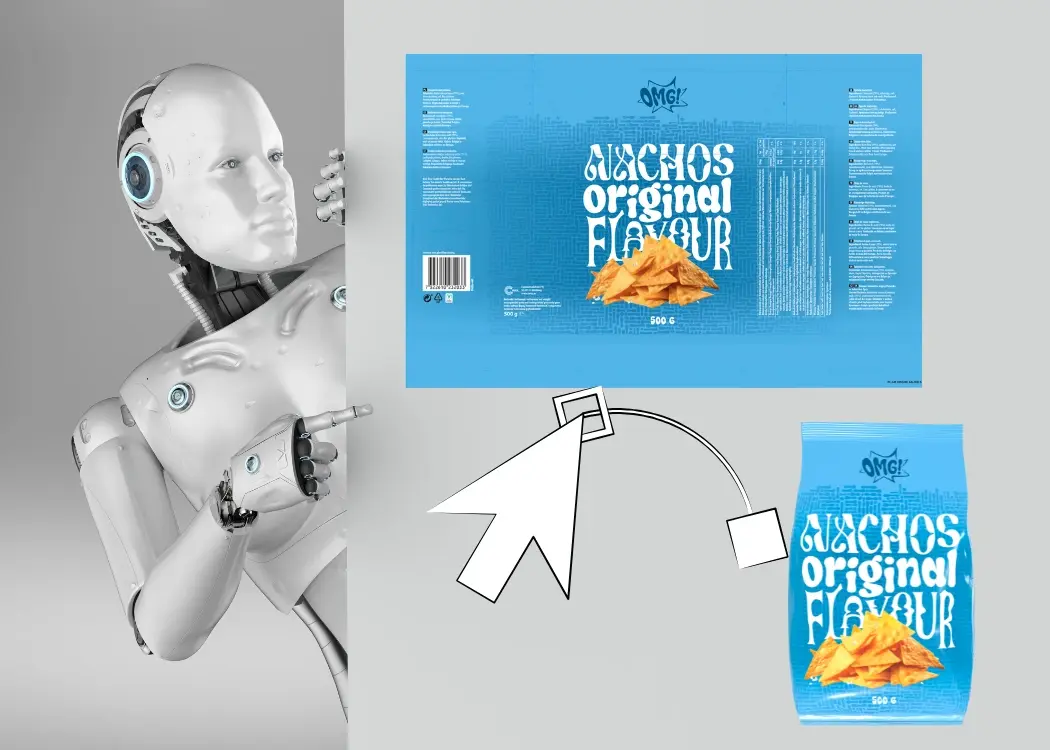
Early-stage ideation now takes minutes, not days.

2 Smart Photo Editing

AI tools automate complex editing techniques:

  • Object removal

  • Background replacement

  • Generative fill

  • Lighting and color corrections

  • Realistic retouching

Photoshop’s Generative Fill and Canva Magic Edit offer near-infinite flexibility with minimal manual work.

3 Upscaling & Quality Restoration

AI can:

  • Fix low-resolution supplier images

  • Restore old assets

  • Denoise and sharpen visuals

This is especially useful for packaging teams dealing with legacy materials or supplier-provided images.

4 Video Generation and Editing

AI video tools support:

  • Text-to-video creation

  • Animating still images

  • Auto subtitles and dubbing

  • Removing backgrounds

  • Market-specific adaptations

Tools like Sora, Descript, and HeyGen reduce video production timelines dramatically.

5 3D & Product Visualization

AI helps generate:

  • Product mockups

  • Virtual environments

  • Material textures

  • 3D-style renderings without a 3D artist

For packaging, this means rapid visualization of a design before it exists physically.

6 Branding & Marketing Graphics

AI accelerates campaign production:

  • Social content variations

  • Animated assets

  • Thematic suggestions

  • Style adaptations

A single design can scale into dozens of market-ready formats.

7 Packaging-Specific Use Cases

This is where AI’s impact becomes transformative:

Concept Layouts

Produce 10–50 layout directions in minutes.

Content Verification

AI can detect:

  • Missing mandatory information

  • Incorrect languages

  • Layout inconsistencies

  • Regulatory risks

Versioning & Localization

Generate multi-market packaging variations with automated:

  • Language changes

  • Size adjustments

  • Color/imagery swaps

  • Market-specific assets

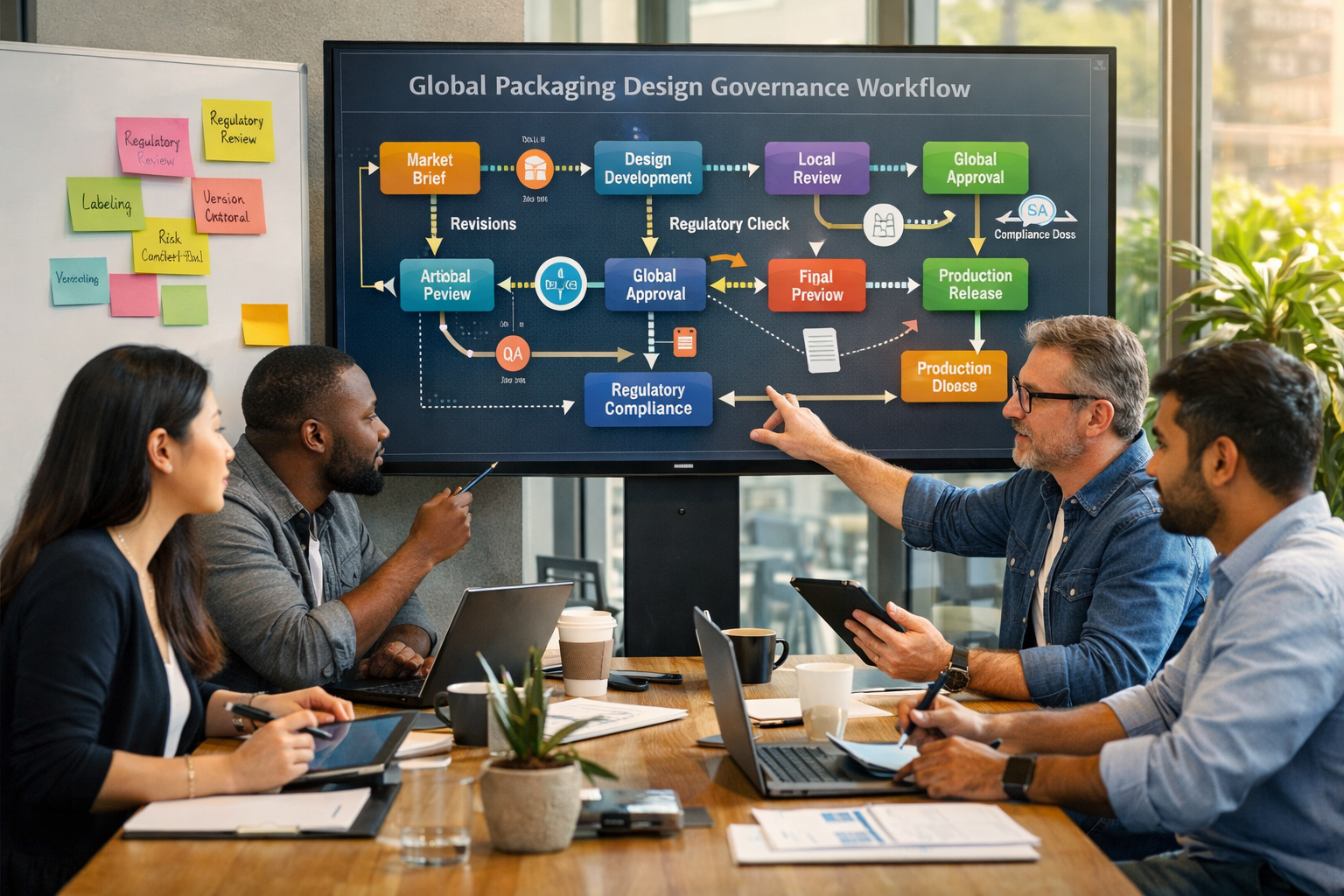
AI accelerates but does not replace compliance review.

AI in Layout, UI & Artwork Production Tools

Tools like Microsoft Office, Figma, Canva, and Adobe now embed AI to:

  • Suggest layouts

  • Expand compositions

  • Generate UI mockups

  • Assist with style consistency

These features reduce manual layout work and help teams stay within brand guidelines.

Limitations of AI in Packaging

Despite its strengths, AI has significant limitations.

Hallucinations

AI may invent details or inaccuracies—dangerous in regulatory-heavy packaging.

Inconsistent Styles

Maintaining brand consistency can be difficult without strict prompt engineering or custom-trained models.

Weak Context Understanding

AI doesn’t inherently know:

  • Brand guidelines

  • Compliance rules

  • Cultural sensitivities

  • Technical print requirements

Not Suitable for Technical Drawings

Die lines, legal text, ingredient lists, symbols, and artwork specifications require human accuracy.

Legal & Ethical Considerations for Packaging Teams

AI introduces new risks:

Copyright Ambiguity

Models are trained on publicly available datasets—sometimes including copyrighted material.

Licensing Differences

Each tool has distinct terms regarding commercial usage, rights, and ownership.

Deepfake Risks

AI can generate misleading or harmful content if misused.

Packaging teams must establish clear internal guidelines on:

  • AI tool selection

  • Asset usage rights

  • Prompt governance

  • Traceability of AI-created content

Human + AI: The New Packaging Designer Role

AI is best seen as a collaborator, not a replacement.

Designer as Director

The designer becomes:

  • Strategist

  • Curator

  • Editor

  • System builder

AI handles repetition and variation; humans handle ideas, taste, and decisions.

You will not be replaced by AI—but by someone with your competence plus AI.

How Packaging Teams Can Start Using AI

A practical adoption strategy:

1. Pick 1–2 Tools

Start with tools aligned to real workflows—generative images, editing, layout assistance.

2. Apply to Real Tasks

Use AI in actual projects, not hypothetical ones.

3. Start Internally

Experiment with low-risk brand work or internal-only visuals.

4. Document Results

Track efficiency improvements, quality changes, and learnings.

5. Combine Graphics AI with LLMs

Use chat-based AI for:

  • Brief writing

  • Metadata generation

  • Compliance checking

  • Content preparation

The combination delivers the real value.

Key Takeaways for Packaging Leaders

  • AI is already practical for packaging design, artwork adaptation, and content control.

  • Human expertise remains essential for compliance, brand management, and final approvals.

  • AI boosts speed and creativity, enabling more variations, faster decisions, and reduced production timelines.

  • Ethics and rights matter: brands must choose tools thoughtfully and establish internal guidelines.

  • Now is the time to test, document, and scale AI within the packaging artwork lifecycle.

AI isn’t replacing packaging designers—it’s empowering them to work smarter, faster, and with greater creative freedom.


Packaging with principles: bringing Fair Trade values to life

Packaging with principles: bringing Fair Trade values to life

World Fair Trade Day, celebrated annually on the second Saturday of May, is more than just a symbolic event—it's a powerful call to action. On May...

View Full Article
Why your team deserves better artwork processes

Why your team deserves better artwork processes

In the fast-paced world of FMCG packaging, every delay, every misstep, and every unclear decision in the artwork process costs time, money, and team...

View Full Article
Why packaging artwork process consulting saves brands millions

Why packaging artwork process consulting saves brands millions

Packaging mistakes cost global brands billions every year — in recalls, redesigns, delays, and lost shelf space. That's why more and more companies...

View Full Article