2 min read

How to build a packaging spec sheet that actually works

How to build a packaging spec sheet that actually works
How to create a packaging spec sheet: template & best practices
4:13

A packaging spec sheet is one of the most underestimated tools in artwork and packaging workflows. It rarely gets attention — until something goes wrong.

Misprints, inconsistent designs, production errors, or endless revision cycles often trace back to the same root cause: missing or poorly structured specifications.

A well-built spec sheet doesn’t just document packaging — it creates alignment across teams, markets, and suppliers.

What is a packaging spec sheet?

A packaging spec sheet is a structured document that defines all technical, visual, and regulatory requirements for a specific packaging format.

It acts as a single source of truth for everyone involved:

  • designers
  • regulatory teams
  • printers and manufacturers
  • marketing teams

Without it, each stakeholder interprets requirements differently — and that’s where inconsistency begins.

Why most spec sheets fail

Many companies technically have spec sheets — but they don’t work in practice.

Common issues include:

  • information scattered across multiple documents
  • outdated versions in circulation
  • unclear ownership
  • lack of standardisation across SKUs
  • missing regulatory or localisation details

As a result, teams still rely on manual clarification, emails, and assumptions.

What a good packaging spec sheet should include

A strong spec sheet is not just detailed — it’s structured and usable.

1. General product information

  • product name and SKU
  • market / region
  • packaging type (box, pouch, bottle, etc.)
  • version / revision number

2. Dimensions and structure

  • exact size (L × W × H)
  • dielines and technical drawings
  • fold lines, bleed, and safety margins

3. Materials and finishes

  • material type (e.g. cardboard, PET, glass)
  • thickness / weight
  • finishes (matte, gloss, embossing, varnish)

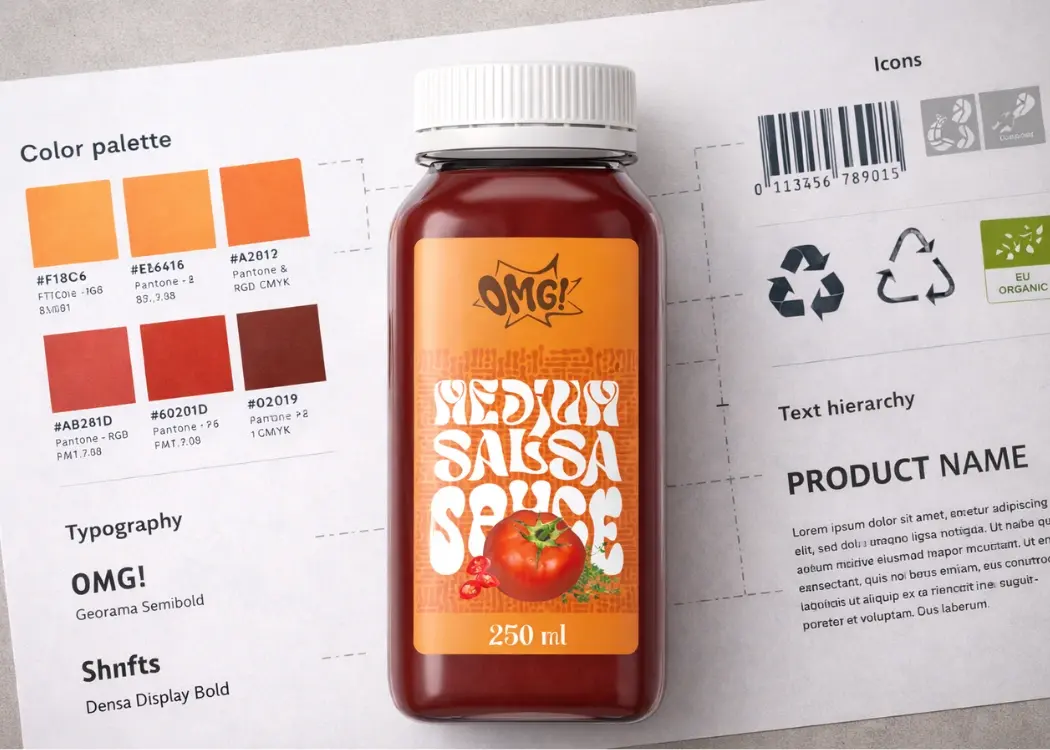
4. Visual identity guidelines

  • colour codes (Pantone, CMYK, RGB)
  • typography (fonts, sizes, hierarchy)
  • logo usage and placement
  • imagery style

This is where brand storytelling becomes operational — not just conceptual.

5. Mandatory content and compliance

  • ingredients / composition
  • legal disclaimers
  • barcodes and QR codes
  • certification marks (recycling, organic, etc.)

This section is critical — and often the most error-prone.

6. Localisation rules

  • language variants
  • region-specific claims
  • regulatory differences

Define what must change — and what must stay consistent.

7. File and artwork requirements

  • file formats (AI, PDF, etc.)
  • naming conventions
  • layer structure
  • export settings

8. Approval workflow

  • responsible stakeholders
  • approval steps
  • version control rules

Without this, even the best spec sheet won’t prevent chaos.

Best practices: what actually makes it work

1. Standardise across all SKUs

Avoid reinventing spec sheets for every product. Use a consistent structure that scales.

2. Keep it structured, not just detailed

More information ≠ better.
Clarity and organisation matter more than volume.

3. Make it accessible

If people can’t find or trust the spec sheet, they won’t use it.

4. Maintain version control

Always ensure teams work from the latest approved version.

5. Integrate into your workflow

A spec sheet should not live as a static file.
It should be part of your operational process.

This is where dedicated artwork management systems like Cway become valuable — they connect specifications, assets, and workflows in one place.

6. Define ownership

Someone must be responsible for keeping the spec sheet accurate and up to date.

The role of structure and tools

At scale, spec sheets cannot be managed manually.

As the number of SKUs, markets, and stakeholders grows:

  • files get duplicated
  • versions diverge
  • errors increase

Structured systems help enforce consistency by design:

  • centralised data
  • controlled access
  • traceable changes
  • clear workflows

This doesn’t just improve efficiency — it reduces risk.

Conclusion

A packaging spec sheet is not just documentation — it’s infrastructure.

It connects brand storytelling, regulatory compliance, and production reality into a single, structured framework.

Without it, inconsistency is inevitable.
With it, scaling packaging across markets becomes predictable and controlled.

Reduce errors and costs with packaging workflow automation

Reduce errors and costs with packaging workflow automation

Have you ever spent hours hunting for the latest packaging file, only to realize someone has been working on an outdated version? Or maybe you’ve...
View Full Article
Avoid reprints and delays with an accurate print proof

Avoid reprints and delays with an accurate print proof

For brands managing packaging, printing is one of the largest operational costs — and yet it’s often treated as a fixed expense rather than an area...

View Full Article
From design to shelf: optimizing printing for FMCG packaging

From design to shelf: optimizing printing for FMCG packaging

Printing may seem like just one step in packaging production, but for food and beverage brands, it’s one of the most critical stages. A misprint, an...

View Full Article