
45.5%
of US FDA food recall events in 2024 were caused by label errors

1. Recalls: the label is now the biggest single risk
Most recalls linked to packaging are not manufacturing failures. The product was made correctly; the label didn't match it.
United States
- In 2024, label errors were the leading cause of FDA food recalls: 192 of 422 recall events, or 45.5%. That was almost three times the second cause, listeria. 83.85% of those label-error recalls involved undeclared allergens. (Loftware analysis of the FDA Enforcement Report database, via New Food Magazine, Jan 2025)
- In 2025, US food and drink recalls reached a nine-year high, according to Sedgwick's 2026 Recall Index: 571 FDA recalls (+15.4% on 2024) affecting 138.5 million units. Undeclared allergens accounted for about 16 million recalled units. (Sedgwick via Just Food / Just Drinks, Feb 2026)
- In Q1 2026, undeclared allergens caused 57 of 140 FDA food recalls, the highest Q1 total in eight years. (TraceGains, US Product Safety and Recall Index, Jun 2026)
- Brand size is no protection. In late 2024, Frito-Lay recalled a limited batch of Lay's Classic chips over undeclared milk, and the FDA upgraded it to Class I, its most serious risk level, in January 2025. (ABC News, Jan 2025)
Europe and Australia
- EU food and feed safety alerts exchanged through the Alert and Cooperation Network rose 11% to 10,490 in 2025. RASFF notifications rose 2% to 5,344. (European Commission annual report, via Brussels Times)
- In Australia, undeclared allergens were again the leading cause of food recalls in 2025, at 38% of all recalls. (Food Standards Australia New Zealand)
Pharma
- A ten-year peer-reviewed analysis of FDA drug recalls (2012–2023) attributes about 19% to labelling and packaging issues. (cited by InformaIT)
- Industry estimates attribute 35–40% of pharmaceutical recalls to pack labelling errors and omissions. (Freyr Solutions)
The cost of a recall
- The average direct cost of a US food recall is about $10 million, and 5% of companies surveyed reported recalls costing over $100 million. (GMA / FMI)
- About 15% of consumers say they would never buy a recalled product again, and 21% would avoid the manufacturer's other products. (Harris Interactive, via Rentokil)
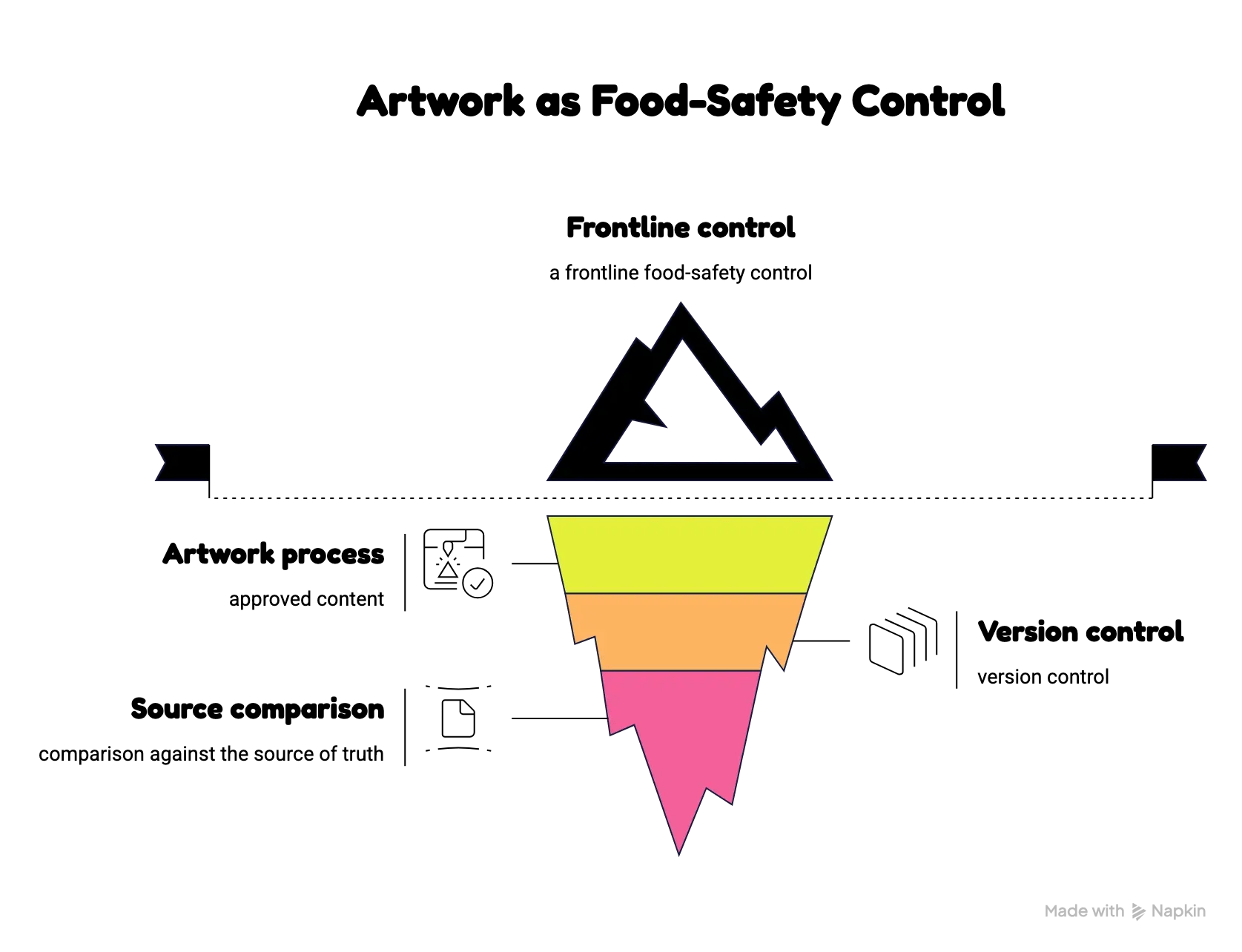
What it means for artwork teams: the artwork process — approved content, version control and comparison against the source of truth — is now a frontline food-safety control, not just a design workflow.
2. Complexity: more SKUs, more variants, more cost
Artwork volume no longer tracks the number of products. It tracks products × markets × languages × channels × regulatory changes.
- The global packaging market is worth about $1.2 trillion in 2025 and is forecast to reach about $1.52 trillion by 2030, at roughly 3.5–3.8% annual growth. (Smithers)
- Digitally printed packaging and labels are expected to grow from $22.0 billion in 2025 to $36.9 billion in 2030, a 10.9% CAGR. More short runs, versioning and personalisation mean more artwork variants. (Smithers, The Future of Digital Print for Packaging to 2030)
- E-commerce packaging was worth about $81.6 billion in 2025 and is forecast to exceed $100 billion by 2028. Each channel needs its own pack images and content. (Smithers × Easyfairs)
Complexity costs money
- SKUs with few shared components cost on average 40.8% more in total cost, and 105% more in packaging materials, than SKUs built from common components. (MIT Center for Transportation & Logistics, 2023)
- McKinsey estimates that managing complexity well can add 1–4 percentage points of net revenue and 3–6 points of margin.
- SKU rationalisation pays, but innovation keeps adding SKUs. L.E.K. Consulting estimates SKU reductions added 65–90 bps to brand owners' gross margins versus 2019. Brands that are adding SKUs cite product innovation, sustainable packaging and new pack sizes as the main drivers. (L.E.K. Annual Packaging Study)
What it means for artwork teams: processes built for a few hundred artworks a year break at a few thousand.
3. Process: where time is lost
Data from the Cway Packaging Artwork Approval Benchmark 2026:
- The average FMCG artwork approval cycle takes 24 calendar days.
- The average project involves 6.8 stakeholders and 6.2 revision rounds.
- 41% of teams still rely primarily on email-based approvals.
- Email-based workflows need 8.4 revision rounds on average, versus 4.1 in structured workflows.
- Each additional revision round adds about 2.3 days.
- 1 in 3 packaging projects misses its intended launch date.
 Why manual review struggles
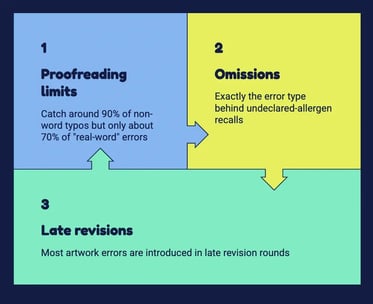
- Human proofreading has hard limits. Proofreaders catch around 90% of non-word typos but only about 70% of "real-word" errors (such as "1 mg" vs "10 mg"), and far fewer omissions. Omissions are exactly the error type behind undeclared-allergen recalls. (R. Panko, human error research)
- Errors enter late. Most artwork errors are introduced in late revision rounds, through a claim change, reformulation or translation update, not when the label is first designed.
4. Regulation: a decade of mandatory artwork change
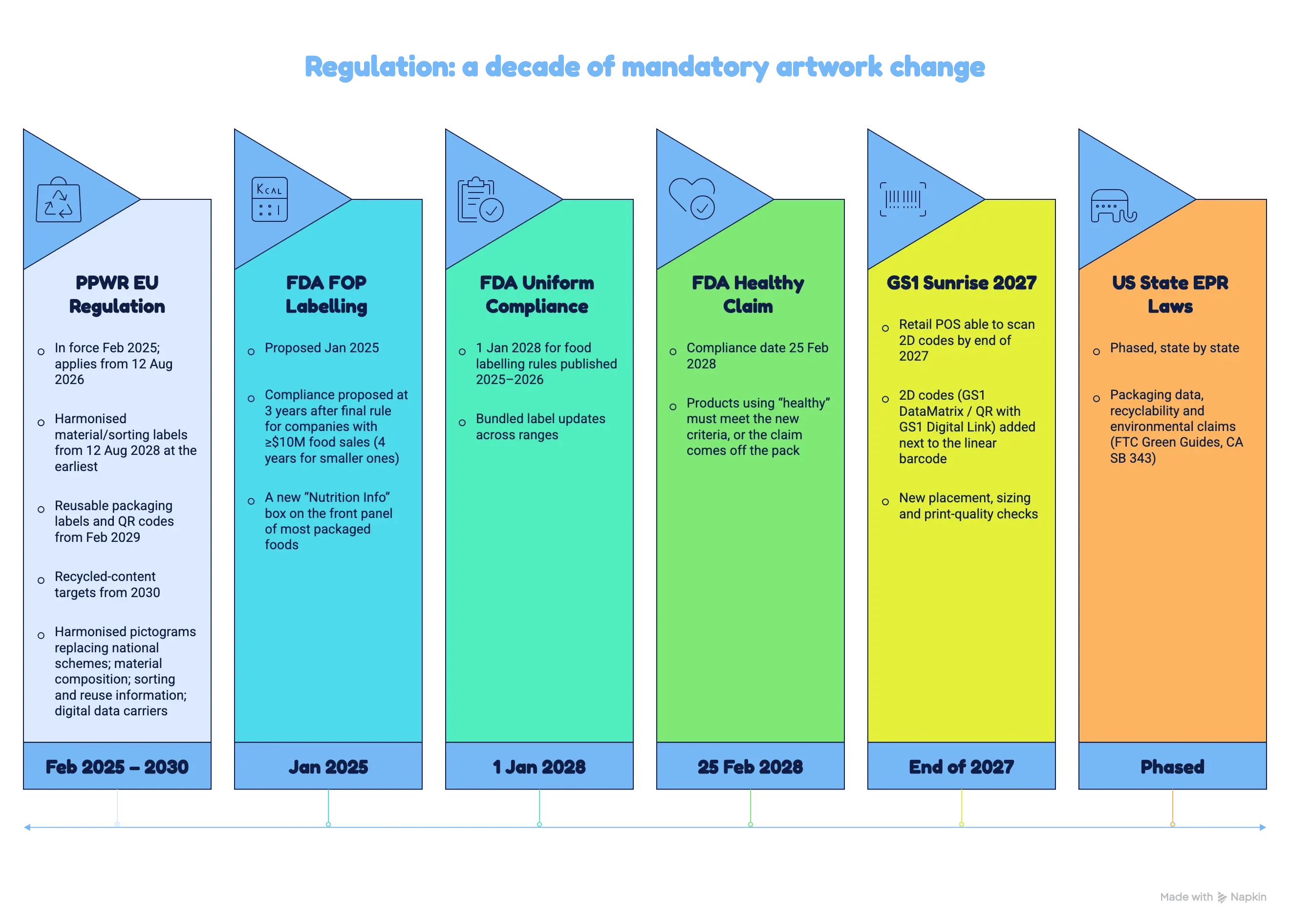
Several regulations now create portfolio-wide, deadline-driven artwork updates, not one-off changes.
| Regulation | Region | Key dates for artwork | What changes on pack |
|---|---|---|---|
| PPWR (Regulation (EU) 2025/40) | EU | In force Feb 2025; applies from 12 Aug 2026; harmonised material/sorting labels from 12 Aug 2028 at the earliest (or 24 months after implementing acts); reusable packaging labels and QR codes from Feb 2029; recycled-content targets from 2030 | Harmonised pictograms replacing national schemes; material composition; sorting and reuse information; digital data carriers |
| FDA “healthy” claim rule | US | Compliance date 25 Feb 2028 | Products using “healthy” must meet the new criteria, or the claim comes off the pack |
| FDA front-of-package (FOP) nutrition labelling | US | Proposed Jan 2025; compliance proposed at 3 years after the final rule for companies with ≥$10M food sales (4 years for smaller ones) | A new “Nutrition Info” box on the front panel of most packaged foods |
| FDA uniform compliance date | US | 1 Jan 2028 for food labelling rules published 2025–2026 | Bundled label updates across ranges |
| GS1 Sunrise 2027 | Global (industry initiative, retailer-driven) | Retail POS able to scan 2D codes by end of 2027 | 2D codes (GS1 DataMatrix / QR with GS1 Digital Link) added next to the linear barcode, with new placement, sizing and print-quality checks |
| US state EPR laws (e.g. California SB 54, plus Oregon, Colorado, Washington, Maryland, Minnesota, Maine) | US | Phased, state by state | Packaging data, recyclability and environmental claims (FTC Green Guides, CA SB 343) |
Sources: TraceOne, FoodNavigator, Coolset, Paxly; Mintz, Hogan Lovells, Eurofins, FDA; GS1 / Videojet / Keyence.
What it means for artwork teams
- The work is cumulative. Between 2026 and 2030, a European or transatlantic brand may need to touch most of its artwork more than once, for PPWR labels, 2D codes, claims and FOP nutrition.
- Dates move. The PPWR labelling date depends on implementing acts, and the FDA FOP rule isn't final. Teams need a living regulatory calendar connected to their artwork pipeline.
- Bundle changes. Combining several mandatory changes in one artwork revision cuts repro and print costs, but only if you can see which SKUs are affected by which change.
5. AI: from interest to early adoption
- In McKinsey's survey of packaging executives, the share whose function had not developed any generative AI capability fell from 70% in 2024 to 18% in 2025. In 2025, 13% had launched a gen-AI function, 33% were developing one and 38% were considering it. (McKinsey, presented at interpack 2026, via Baking Business)
- In the 2025 survey of 110 senior packaging leaders, 82% said their function had launched, was developing or was considering gen-AI solutions. 56% reported machine learning or gen-AI use in commercial excellence, versus 43% in procurement and 37% in supply chain. The main barriers were IP and privacy concerns and unclear value cases. (McKinsey, via Packaging Gateway)
- An earlier McKinsey survey of more than 200 paper and packaging executives found 95% believed their companies should invest in gen AI, and 77% had moderate to strong intentions to use it. (via Packaging Dive)
- 73% of respondents to Esko's Packaging Trends 2025 Survey named automation, AI and machine learning as the biggest impact on the industry in 2025. (Esko)
- On the marketing side, McKinsey estimates gen AI could lift marketing productivity by 5–15% of total marketing spend, about $463 billion a year. Yet in 2024 only 4% of consumer CMOs said they were scaling gen-AI use cases. (McKinsey)
Where AI helps artwork management, and where it doesn't (yet)
| Strong today |
Still needs deterministic checks and human sign-off |
|---|---|
| Flagging likely issues: missing elements, inconsistencies across variants, layout and legibility | Exact text comparison against approved copy |
| Running simple, user-defined rules at scale (e.g. allergen emphasis, mandatory statements present) | Barcode, 2D code and Braille verification with documented evidence |
| Finding and reusing past artwork content and decisions | Final regulatory, legal and brand judgement |
| Generating variants and digital pack imagery | Audit trails for regulated categories |
What it means for artwork teams: AI's value depends on clean inputs — approved content, structured product data and a single source of truth for files and decisions. Teams still running artwork through email and shared drives will struggle to use AI safely.
6. People: the artwork role is becoming a process-owner role
Cway analysis of around 130 artwork, packaging and brand job postings published in 2026 in Europe and North America.
- Hub models are spreading. Large groups increasingly run artwork from shared-service hubs, for example in Lisbon, Kraków, Warsaw and Wrocław.
- The scope is widening from print artwork to CGI pack images, e-commerce content, regulatory change programmes and stock-switch planning (SLOB and write-off avoidance).
- Employers measure outcomes: Right First Time, OTIF, SLA adherence, cycle time, quality incidents, revision rounds.
- Senior roles own the system and the process: selecting artwork management systems, running RCA/CAPA, leading teams and managing artwork budgets.
→ Full breakdown in Inside the Role of an Artwork Manager: Responsibilities and Skills.
7. What leading teams do differently: 7 recommendations
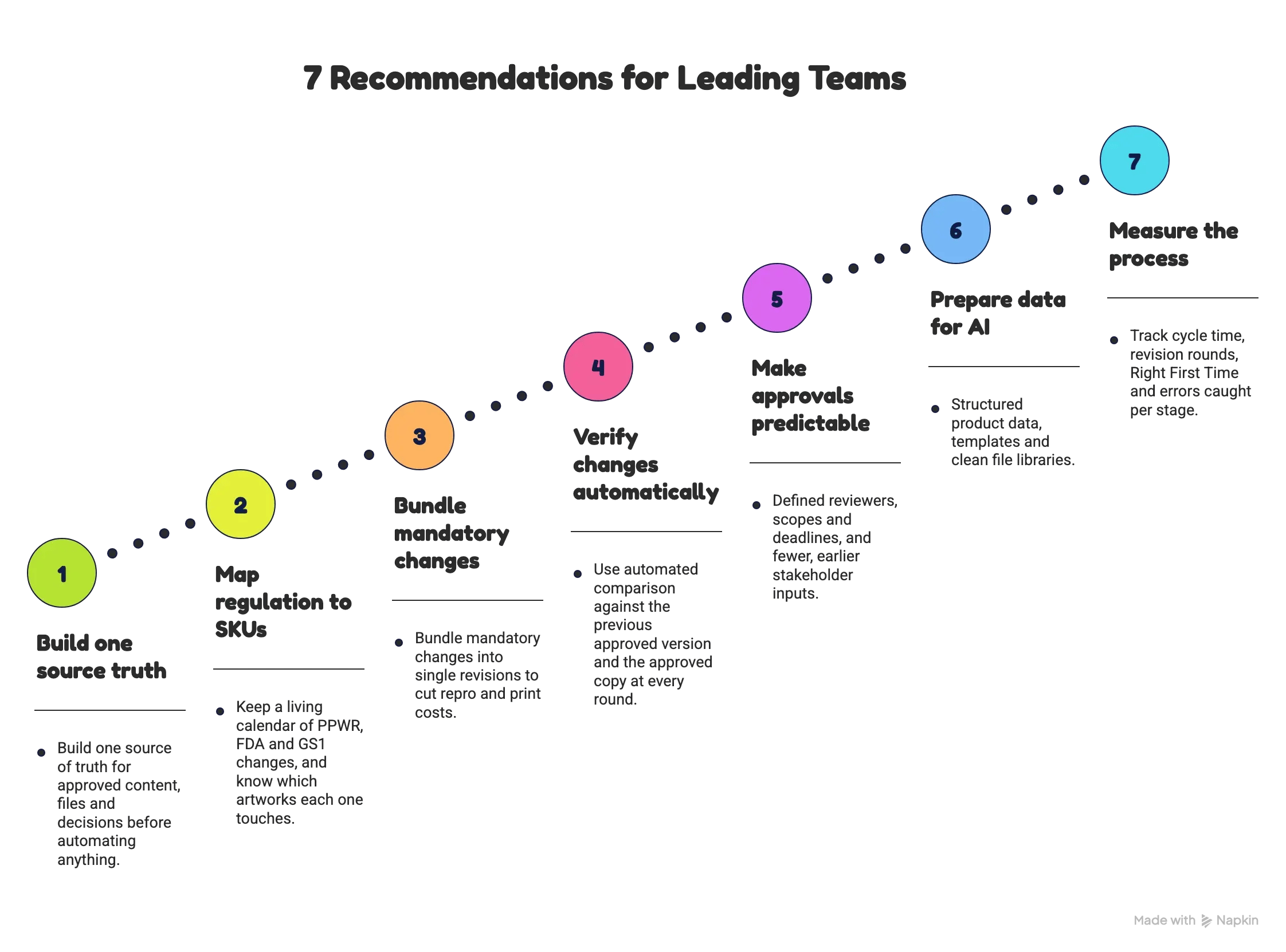
- Build one source of truth for approved content, files and decisions before automating anything.
- Map regulation to SKUs. Keep a living calendar of PPWR, FDA and GS1 changes, and know which artworks each one touches.
- Bundle mandatory changes into single revisions to cut repro and print costs.
- Verify changes, don't re-read everything. Use automated comparison against the previous approved version and the approved copy at every round.
- Make approvals predictable: defined reviewers, scopes and deadlines, and fewer, earlier stakeholder inputs.
- Prepare data for AI first: structured product data, templates and clean file libraries.
- Measure the process. Track cycle time, revision rounds, Right First Time and errors caught per stage.
Methodology and data notes
- This report combines publicly available third-party research (McKinsey, Smithers, Sedgwick, Loftware, TraceGains, L.E.K. Consulting, MIT CTL, GMA/FMI, regulators and industry bodies) with Cway's own research: the Packaging Artwork Approval Benchmark 2026 and an analysis of job postings.
- Figures are reported as published by their sources. They are not always directly comparable, because sources use different methods and definitions, for example recall events vs recalled units, or FDA vs FDA + USDA.
- Regulatory dates reflect information available in November 2026. Some dates depend on implementing acts or final rules and may change. This report is not legal advice.
- Market size of artwork management software: published estimates vary widely between research firms, from roughly $0.6 billion to several billion dollars, depending on definitions. We therefore don't quote a single figure.