
7 min read

Packaging revision control for global FMCG variants

Packaging revision control for global FMCG variants
13:59

Managing packaging across dozens of markets sounds straightforward until you're three versions deep into an allergen label update for six language variants, and nobody can confirm which file went to the printer in Germany. Packaging revision control exists to solve exactly this problem—and if you're running global FMCG operations, getting it right can cut weeks off your approval cycles.

This guide covers everything you need to know about versioning, role-based approvals, and audit trails for packaging artwork. You'll learn how to build workflows that reduce rework, maintain compliance documentation, and give every stakeholder confidence that the file they're approving is the correct one. Cway helps packaging teams centralize this entire process in one platform, connecting artwork, approvals, and audit history from brief to print-ready file.

Key Takeaways: Packaging Revision Control for Global FMCG Variants

  • Packaging revision control tracks every change to your artwork files, ensuring you always know which version is current and approved.
  • Role-based approvals route artwork through the right stakeholders in sequence—brand, regulatory, legal, and production—without bottlenecks.
  • Audit trails create time-stamped records of every decision, protecting your brand during compliance audits and product recalls.
  • Cway centralizes versioning, approvals, and audit history in one platform, reducing approval cycles by up to 70%.
  • Structured workflows eliminate version confusion across multilingual packaging variants and high SKU counts in global FMCG operations.

What Is Packaging Revision Control?

Packaging revision control is the systematic process of tracking, managing, and documenting every change to your packaging artwork files. It ensures that everyone involved in your packaging workflow is working from the correct version—and that you can prove it.

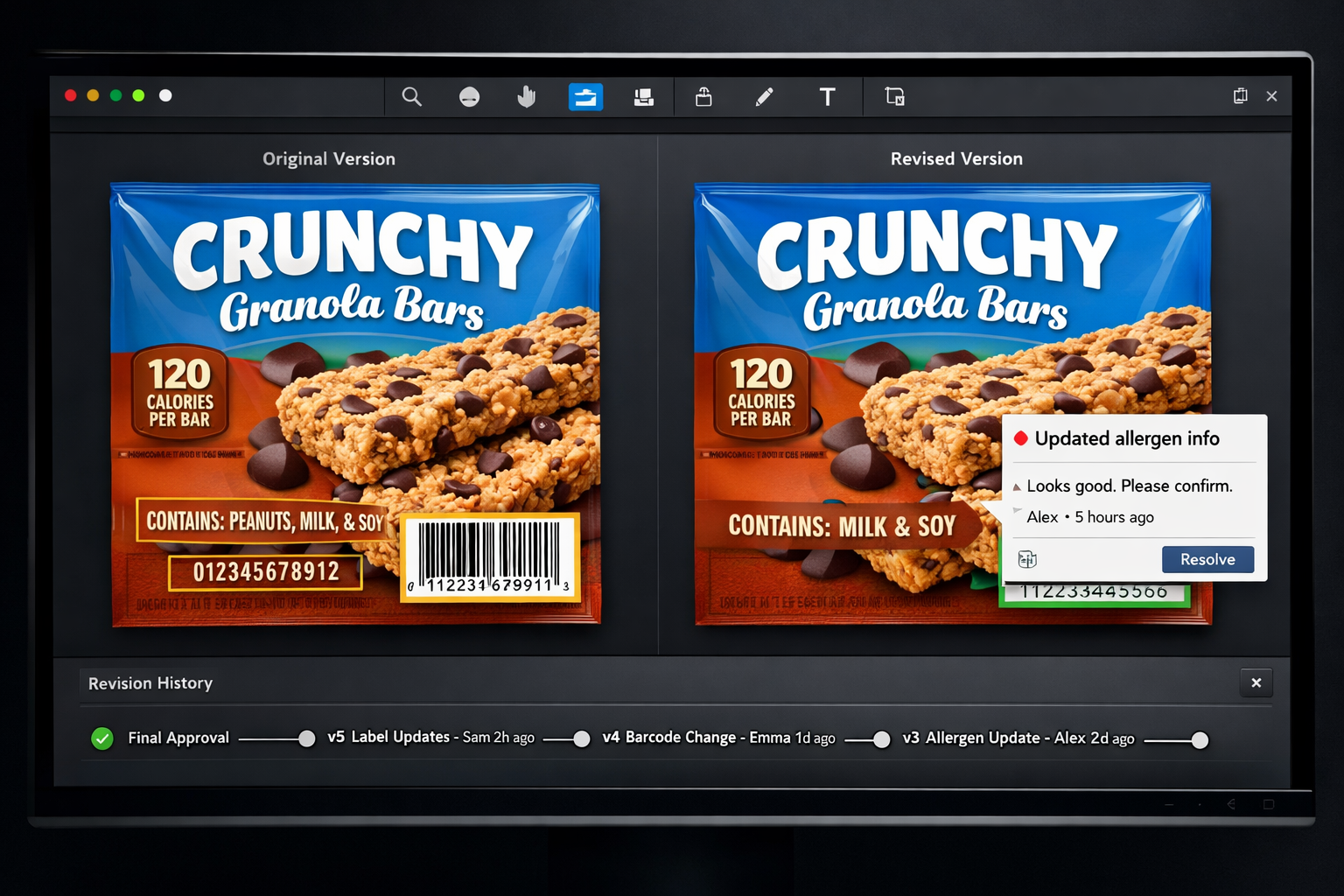
In practice, revision control covers three core functions. First, it maintains a clear version history so you can see exactly what changed between iterations. Second, it enforces approval gates that prevent unapproved changes from reaching production. Third, it creates an auditable record of who approved what, and when.

For FMCG brands managing hundreds or thousands of SKUs across multiple markets, this structure prevents the costly errors that come from version confusion—wrong labels reaching shelves, regulatory non-compliance, or expensive reprints.

Why Does Version Control Matter for FMCG Packaging?

FMCG packaging isn't static. Ingredients change. Claims get updated. Regulations shift. Markets require different languages, symbols, and legal statements. Every one of these changes creates a new version of your artwork—and every version needs to be tracked, reviewed, and approved.

Without structured version control, you're relying on file naming conventions, memory, and email threads to keep track of what's current. That approach fails at scale. According to research from Cway's Packaging Artwork Approval Benchmark, the average FMCG artwork project involves 6.2 revision rounds and takes 24 calendar days to complete. One in three projects misses its intended launch date.

Structured revision control reduces these numbers by eliminating the back-and-forth that comes from unclear feedback, lost versions, and approval confusion. When every stakeholder can see the current version, its history, and pending approvals, projects move faster.

How Does Packaging Revision Control Reduce Rework?

Rework happens when changes are made to the wrong version, feedback gets lost between rounds, or approvers sign off on files that haven't incorporated previous corrections. Revision control eliminates these failure points.

When you work in a structured system, each revision is linked to the previous one with a clear record of what changed. Reviewers see exactly what they're commenting on, and their feedback attaches directly to the correct version. Designers know precisely which file to update, and approvers can verify that all requested changes have been made before signing off.

This visibility reduces revision rounds because feedback is consolidated, not scattered. It also prevents the expensive late-stage discoveries—like finding out at prepress that someone approved an outdated file—that force entire projects back to earlier stages.

What Are Role-Based Approval Workflows in Packaging?

Role-based approval workflows define who needs to review artwork at each stage and in what sequence. Instead of building approval chains around specific individuals (who may go on leave or change roles), you build them around functions: Brand Custodian, Regulatory Reviewer, Legal Approver, Production Sign-off.

This structure has two advantages. First, it ensures nothing moves forward until the right expertise has reviewed it. A packaging claim doesn't reach the printer without regulatory approval. A design change doesn't go live without brand sign-off. Second, it makes your workflow resilient. When individuals change, the system adapts automatically because approvals are tied to roles, not names.

Effective role-based workflows also define dependencies. For example, you might require regulatory approval before legal review, or brand approval before production can download final files. These sequences prevent stakeholders from working in parallel on files that haven't passed earlier gates.

How Do You Set Up Sequential Approval Stages?

Start by mapping the stages every artwork moves through in your organization. A typical sequence includes briefing, design, internal review, regulatory review, legal review, final approval, and printer handoff. Your sequence may differ based on your category, market requirements, and organizational structure.

For each stage, define: who is responsible for approval, what criteria must be met to pass, and what happens if the stage fails. Clear pass/fail criteria prevent the ambiguity that leads to "approved with comments" situations—where files move forward even though issues remain unresolved.

Build your workflow so that failed stages return to the appropriate earlier point. If regulatory review uncovers a claim issue, the file should route back to design—not to the next stage—with clear documentation of what needs to change.

What Roles Should Be Included in Packaging Approvals?

The specific roles depend on your organization, but most FMCG packaging workflows include several core functions. Brand or marketing reviews ensure the design aligns with brand guidelines and campaign requirements. Regulatory reviews verify that claims, ingredients, and required statements comply with market-specific regulations.

Legal reviews confirm that trademarks, certifications, and legal disclaimers are correctly presented. Quality or technical reviews check that the artwork meets production specifications—dimensions, color profiles, barcode placement, and print requirements. Finally, production sign-off confirms the file is technically ready for the printer or converter.

Some organizations add stages for local market review (when central teams create artwork for regional use) or external stakeholder approval (when retailers or partners require sign-off).

How Do Audit Trails Protect Your Brand During Recalls?

An audit trail is a time-stamped record of every action taken on a packaging file: who uploaded it, who reviewed it, what comments were made, who approved it, and when each action occurred. This documentation becomes critical during two scenarios: compliance audits and product recalls.

During an audit, regulators may ask to see evidence that your packaging claims were reviewed by qualified personnel before reaching market. An audit trail shows exactly that—with timestamps, names, and documented decision points. According to UK Food Standards Agency guidance, food businesses must be able to demonstrate traceability and show that appropriate controls were in place.

During a recall, you need to answer questions fast: Which version of this label was approved? When was it sent to the printer? Who signed off on the claim that's now under scrutiny? If those answers require digging through years of email threads, you've lost valuable time. With a structured audit trail, those answers are available immediately.

What Should Your Audit Trail Include?

A complete audit trail captures several types of information. File history includes every version uploaded, with clear identifiers distinguishing them. Decision records show approvals, rejections, and requests for revision—each with the reviewer's name and timestamp.

Comment history preserves all feedback given during review, tied to the specific version and location on the artwork where the comment applies. Handoff records document when files were released to external parties (printers, converters, agencies) and confirm which version was sent.

Access logs show who viewed or downloaded files and when. This becomes important if you need to trace how a particular version reached a particular location in your supply chain.

What Challenges Do Global FMCG Brands Face with Revision Control?

Managing packaging across multiple markets introduces complexity that single-market operations don't experience. Each market may have different regulatory requirements, language needs, and approval stakeholders. A single product might require fifteen label variants—and each variant has its own revision history.

How Do You Manage Multilingual Packaging Variants?

Multilingual packaging multiplies your version control challenge. A single text change—like updating an allergen statement—may need to propagate across every language variant. If those variants are tracked separately, you risk some getting updated while others are missed.

The solution is to treat multilingual variants as linked assets. When the master text changes, the system flags all affected variants for translation and re-approval. This linkage ensures consistency and creates an audit trail showing that all language versions went through equivalent review processes.

How Do Different Markets Affect Approval Workflows?

Different markets have different regulatory bodies, different claim requirements, and different labeling standards. The EU requires specific recycling symbols. The US has FDA-specific nutrition labeling requirements. Individual countries may require additional certifications or statements.

Your revision control system needs to accommodate market-specific workflows without creating completely separate processes for each market. This typically means defining a core workflow that applies globally, with market-specific stages or checkpoints that activate based on the packaging's destination.

What Technology Features Support Effective Revision Control?

The right technology makes revision control practical at scale. Without it, even well-designed processes break down under the volume and complexity of global FMCG operations.

What Should You Look for in Revision Control Software?

Automatic versioning is essential. Every time a file is uploaded, the system should assign a clear version identifier and maintain the complete history of previous versions. Users should never need to manually track versions through file names.

Visual comparison tools let reviewers see exactly what changed between versions. Side-by-side or overlay views highlight differences in text, images, and layout—making review faster and more accurate.

Integrated proofing allows comments and annotations to attach directly to specific locations on the artwork. This context ensures designers understand exactly what reviewers are referencing, reducing clarification rounds.

Workflow automation routes files through approval stages automatically, sends notifications when tasks are due, and escalates overdue items. This keeps projects moving without requiring manual follow-up.

How Does Cway Support Packaging Revision Control?

Cway centralizes your entire packaging artwork lifecycle in one platform. Every version of every file is stored with complete history and automatic versioning. Approval workflows route artwork through required stages with role-based assignments, and the system maintains a complete audit trail of every decision.

Visual comparison tools let reviewers overlay versions to spot differences. Integrated annotation keeps feedback attached to the exact location on the artwork where issues occur. And cross-portfolio visibility shows the status of every active project across all your brands and markets.

In Summary: Building a Revision Control Process That Scales

Packaging revision control isn't a single tool or technique—it's a discipline that combines clear processes, defined roles, and appropriate technology. When these elements work together, you gain the ability to move packaging through approval faster, with fewer errors, and with complete confidence that the right version reaches the right market.

For global FMCG brands, this discipline becomes increasingly important as SKU counts grow, regulatory requirements tighten, and market timelines compress. The organizations that master revision control don't just avoid errors—they turn packaging operations into a competitive advantage.

Start by assessing your current state honestly. Map your workflows, identify your pain points, and define the audit trail capabilities you need. Then build toward a process that gives every stakeholder clarity about versions, approvals, and status—whether they're reviewing a single label or managing a portfolio of thousands.

Global packaging design governance workflows in 2026

Global packaging design governance workflows in 2026

Running packaging design for a single market is complex. Running it across five, ten, or twenty markets—each with distinct regulations, languages,...

View Full Article
10 must have annotation features for packaging approvals

10 must have annotation features for packaging approvals

Annotation and markup tools can make or break your packaging artwork approval process. When you're reviewing files that contain allergens, legal...

View Full Article
Automating your compliance workflow for faster approvals

Automating your compliance workflow for faster approvals

In regulated industries like food & beverage, pharmaceuticals, or cosmetics, every detail on your packaging must meet strict legal and brand...

View Full Article