Managing 3,000 artworks a year: how FMCG brands stay in control
Three thousand packaging artworks a year. That's not an edge case — it's a realistic volume for any mid-to-large FMCG brand managing multiple product...
6 min read
Ekaterina Skalatskaia
:
July 15, 2026
There is a familiar pattern in how packaging teams end up evaluating artwork management software. A coordinator spends half their day chasing approvals over email. A launch slips because no one can confirm which version of the file is current. A compliance review surfaces a problem that was introduced three rounds ago and nobody noticed. Someone decides enough is enough, and the search for a solution begins.
The search usually ends with a demonstration of a platform that looks impressive. Dashboards. Workflow automation. File viewers. The promise of replacing the email chaos with something structured and traceable.
What happens next is where most implementations diverge from expectations — and understanding why reveals something important about what mid-market brands actually need from artwork management.
The instinct when something is broken is to add structure. Buy a system. Map the current process into it. Train the team. Launch.
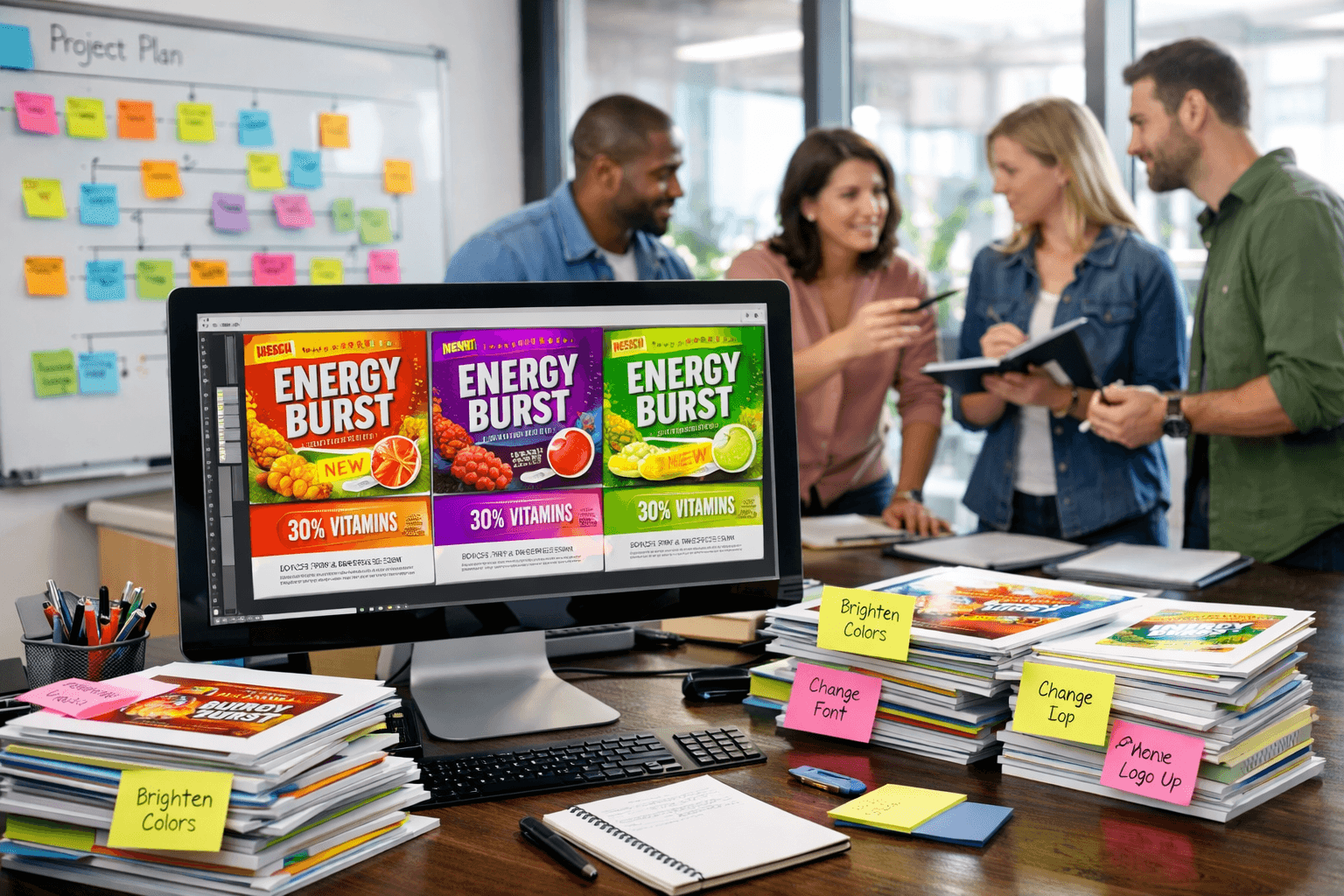
The problem is that adding a system to a broken process often produces a more complicated version of the same broken process. Teams that were losing files in shared drives start losing files in a more expensive shared drive. Approvals that were tracked in email threads get tracked in a different interface — but the same stakeholders are still disconnected, the same feedback still arrives late, and the same version confusion still produces the same rework.
This is the "more system" trap: the assumption that the operational problem is a tooling gap, when the actual problem is a collaboration and visibility gap that a tool alone cannot close.
The distinction matters because it changes what you evaluate when you're choosing a solution. The question is not "does this platform have the features we need?" The question is "will this platform change the way our team actually works?"
To understand what mid-market brands need, it helps to be specific about where the operational pain actually lives.
A packaging coordinator managing dozens of active SKUs across multiple markets is not primarily struggling with file storage. They are struggling with visibility: at any given moment, they need to know where each artwork is in the process, who has it, what feedback has been given, and what version is current. Without that visibility, they spend most of their time chasing status updates rather than moving work forward.
The reviewers — brand managers, regulatory teams, legal, external agencies — are not primarily struggling with access to files. They are struggling with context: when a file arrives for review, is it clear what changed from the previous version, what specifically needs to be checked, and what the deadline is? Without that context, reviews take longer than they should and produce feedback that is less useful than it could be.
The people responsible for sign-off are not primarily struggling with the mechanics of approval. They are struggling with confidence: before they sign off, they need to be certain that what they are approving is the correct version, that all required reviewers have seen it, and that their approval will be recorded in a way that is retrievable if questions arise later.
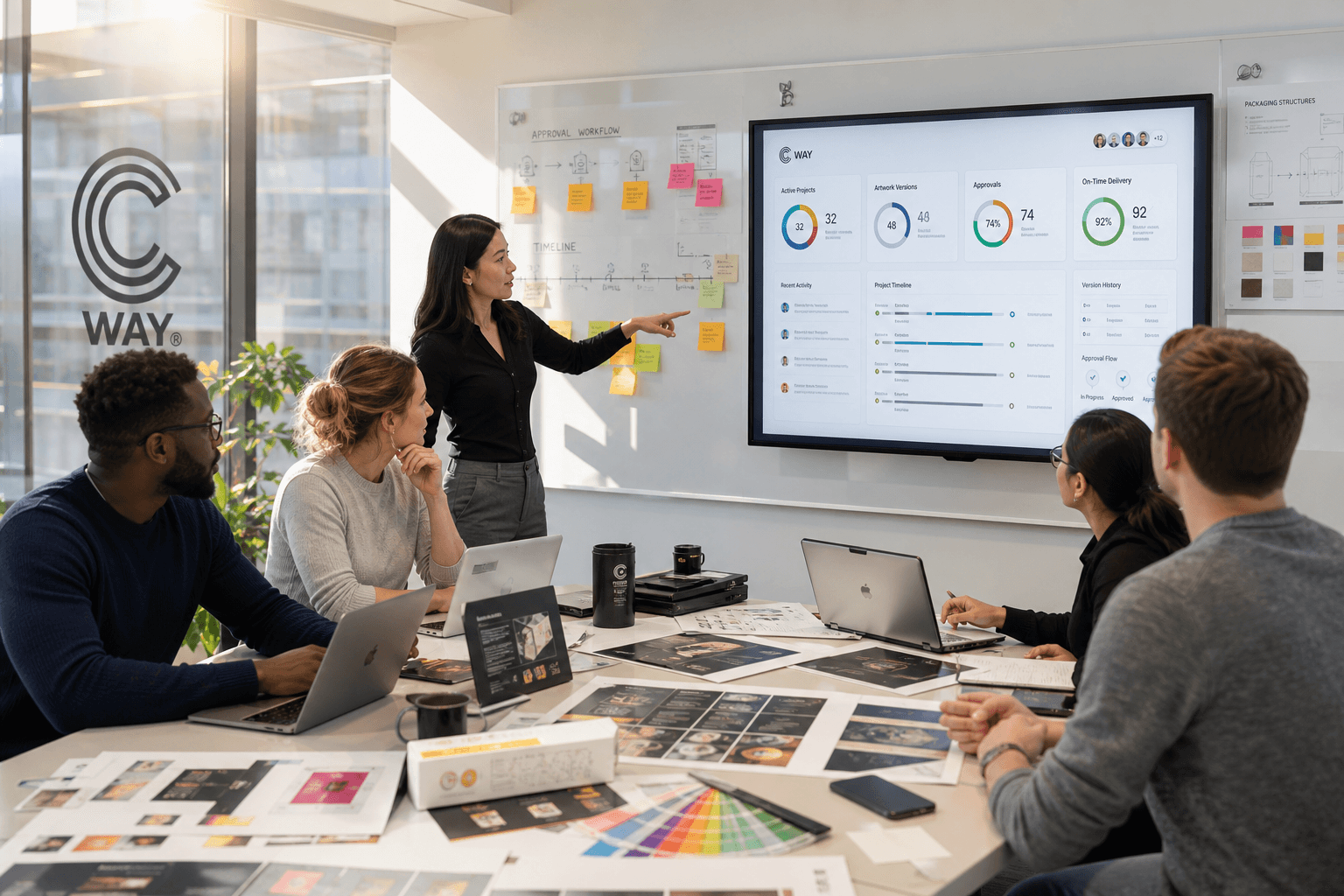
An artwork management platform that addresses these problems gives the coordinator real-time visibility into every active project from a single dashboard, gives reviewers structured context when files arrive for their input, and gives approvers a clear and permanent record attached to the specific version they signed off on. That is a different proposition from a platform that stores files and tracks tasks.
One of the most consistent gaps between what artwork management platforms promise and what teams actually experience is in collaborative review.
The promise is that reviewers can annotate directly on the file, feedback is centralised, and the back-and-forth of email is eliminated. The reality, in many implementations, is that reviewers still default to email because the annotation interface is clunky, or because external stakeholders — agencies, print suppliers, regulatory consultants — can't easily access the system without a paid seat or a lengthy onboarding.
What artwork approvals and proofing actually requires is a viewer that makes the review experience better than email, not just different from it. That means rendering files at the quality level where a reviewer can actually see what they are evaluating — colour accuracy, text legibility, barcode placement. It means annotations that are precise enough to replace a "see attached marked-up PDF" workflow. It means version comparison that shows exactly what changed between round three and round four, so the reviewer doesn't have to reconstruct the diff manually.
When the review experience is genuinely better, adoption follows naturally. When it isn't, teams revert to the tools they already know — and the system becomes an overhead rather than an improvement.
One of the most significant operational inefficiencies in packaging approval workflows is sequential review: the file goes to legal, legal sends it to regulatory, regulatory sends it to the brand manager, the brand manager sends it back with comments that require another round. The total elapsed time is the sum of every individual review cycle.
The alternative is not to compress individual review time or skip steps — it is to run reviews in parallel. When legal, regulatory, and brand management can review the same version of the same file simultaneously, each contributing their feedback directly without waiting for the previous reviewer to finish, the total elapsed time collapses to the longest individual review rather than the sum of all of them.
This is not a trivial operational change. For a brand managing hundreds of active artworks, reducing average approval cycle time by even a few days per artwork compounds into weeks of recovered time per quarter. Products reach shelf sooner. Last-minute compliance corrections that used to trigger reprints get caught earlier. The coordinator spends less time managing the queue and more time managing the work.
Version control is often described as a feature. It is more accurate to describe it as infrastructure — the foundation that makes everything else reliable.
When version control is properly implemented, "which file is current" is never a question that requires a conversation. The answer is visible to everyone who needs it, attached to the file itself, with a complete history of every previous version and the changes made between them. An approver who signs off on version 14 cannot accidentally approve version 11. A coordinator sending a file to print cannot accidentally send the wrong version.
Without that infrastructure, the operational cost of version confusion accumulates steadily and invisibly. Rework caused by feedback given on the wrong version. Reprints caused by an outdated file making it to prepress. Recall risk from a compliance update that was made in one version but not carried through to the version that shipped. These costs are real, but they rarely appear on any single line item — they are distributed across design agency invoices, production delays, and the coordination time that nobody tracks.
Audit logs sit alongside version control as part of the same infrastructure. The record of who accessed which version, when, and what they did with it is not primarily a compliance feature — it is an operational one. When something goes wrong, that record is what makes the problem diagnosable and fixable. Without it, investigations become interviews, and the same problem tends to recur.
There is a specific failure mode that mid-market brands hit as they grow: artwork and assets managed in a digital asset management system that has no connection to the workflow where those assets are actually used.
The DAM has the approved logo files. The artwork management system has the packaging projects. The connection between them is a human — someone who downloads from one system and uploads to the other, hoping they have the right version and that nothing has changed since they last checked.
This gap is not a minor inconvenience. It is a version control risk at the asset level: a logo that was updated in the DAM but not in the packaging project, a legal disclaimer that changed but wasn't propagated to the market variants that reference it. The operational answer is not two better-maintained systems — it is one connected system where assets, projects, versions, and approvals all live together and reference each other directly.
Most packaging teams have no reliable data on where their process actually loses time. They know it takes longer than it should. They suspect certain reviewers are bottlenecks. They have a sense that some product categories generate more rework than others. But they are working from intuition rather than evidence.
Artwork analytics — real data on approval cycle times, revision counts, bottleneck locations, rework rates by project type — turns that intuition into something actionable. A team that can see that 40% of their rework originates in one review stage can do something about it. A team that can only feel that something is inefficient cannot.
For the brands that are using artwork management data strategically, the platform stops being an operational tool and starts being a source of competitive advantage: faster launches, lower cost per artwork, fewer compliance incidents, and leadership visibility into packaging operations that enables better resourcing and planning decisions.
The word "partner" gets used loosely in software sales. In the context of artwork management, it has a specific operational meaning.
A system vendor delivers software and support. A partner delivers outcome orientation: the combination of structured tools, workflow expertise, and operational understanding that produces better packaging processes, not just better-organised chaos.
For mid-market FMCG brands — brands managing significant SKU portfolios across multiple markets, with real compliance requirements and real consequences when things go wrong — the distinction matters. The question at the evaluation stage is not just "does this platform do what we need?" It is "will this platform, combined with the expertise of the team behind it, actually change our results?"
That is the right question. And it is a harder question to answer from a product demonstration than from a conversation about how your packaging operations work today and what they need to look like.
Cway is an artwork lifecycle management platform built for packaging teams who need speed, accuracy, and control at scale — and backed by Collabra's two decades of operational expertise in packaging artwork management.
Three thousand packaging artworks a year. That's not an edge case — it's a realistic volume for any mid-to-large FMCG brand managing multiple product...
As FMCG organizations manage growing product portfolios, faster launch cycles, and increasing regulatory complexity, artwork management platforms...
If you’ve ever managed packaging artwork across multiple SKUs, markets, and deadlines, you already know the reality: it’s not the design that slows...