4 min read

EU food packaging compliance: what your artwork platform must do

EU food packaging compliance: what your artwork platform must do
7:04

Food packaging compliance in the European Union is becoming increasingly complex.

Brands must manage multilingual packaging, ingredient updates, allergen declarations, nutrition information, sustainability claims, and country-specific requirements across multiple markets. At the same time, regulators expect companies to demonstrate exactly how packaging decisions were reviewed, approved, and released.

The challenge is not simply creating compliant packaging.

The challenge is proving that every change was reviewed correctly, approved by the right stakeholders, and implemented using the correct artwork version.

This is where artwork management platforms play a critical role.

A modern packaging workflow system should do more than route approvals. It should provide the traceability, governance, and control needed to support compliance throughout the packaging lifecycle.

Why Compliance Is No Longer Just a Regulatory Team Responsibility

Many packaging errors do not originate from regulatory interpretation.

They originate from operational failures:

  • Teams reviewing the wrong artwork version
  • Approval decisions buried in email threads
  • Missing records of who approved changes
  • Last-minute edits made without proper review
  • External agencies working from outdated files

When these issues occur, the result can be costly:

  • Packaging recalls
  • Market withdrawal actions
  • Delayed product launches
  • Increased audit risk
  • Damage to brand reputation

Compliance therefore depends not only on regulatory expertise but also on the systems used to manage packaging workflows.

What Regulators Expect to See

Whether organizations operate under EU food labeling regulations, internal quality standards, or highly regulated environments influenced by Annex 11 principles, auditors typically expect answers to several fundamental questions:

  • Who approved this artwork?
  • When was it approved?
  • What changed between versions?
  • Which version was released for production?
  • Who had permission to make the change?
  • Can the approval history be reconstructed?

If a company cannot answer these questions quickly and confidently, compliance risk increases significantly.

1. Complete Audit Trails

Every packaging change should be fully traceable.

A compliant artwork platform should automatically record:

  • Artwork uploads
  • Version changes
  • Comments and annotations
  • Approval decisions
  • Workflow actions
  • User activity

Most importantly, these records should be preserved as part of a permanent audit history.

Audit trails create accountability and provide evidence during internal reviews, customer audits, and regulatory inspections.

Without them, packaging teams often rely on emails, spreadsheets, and manual documentation to reconstruct decisions after the fact.

2. Robust Version Control

Version confusion remains one of the most common causes of packaging errors.

A modern artwork platform should maintain a complete history of every revision while clearly identifying:

  • Current versions
  • Previous versions
  • Approved versions
  • Obsolete versions

Reviewers should be able to compare revisions and understand exactly what changed before approving artwork.

Strong version control reduces the risk of outdated packaging reaching production.

3. Controlled Approval Workflows

Compliance requires more than collecting approvals.

It requires ensuring approvals happen in the correct sequence.

For example:

  • Regulatory review
  • Quality review
  • Marketing approval
  • Final release

A packaging platform should allow organizations to define approval workflows that match their internal governance requirements.

The system should automatically route tasks, enforce review stages, and maintain visibility into outstanding approvals.

4. Role-Based Access Control

Not every user should be able to perform every action.

Compliance-focused organizations require clear control over:

  • Who can review artwork
  • Who can approve changes
  • Who can release files
  • Who can modify workflows

Access permissions should be managed centrally and supported by complete activity logs.

This helps organizations demonstrate governance and reduce operational risk.

5. Traceable Collaboration with External Partners

Packaging development rarely happens entirely in-house.

Agencies, printers, prepress providers, translators, and suppliers often participate in the review process.

The challenge is maintaining visibility while collaborating externally.

A modern platform should allow controlled external participation without sacrificing traceability.

Every comment, revision, approval, and file exchange should remain visible within the system.

6. Centralized Documentation and Evidence

Audits become significantly easier when documentation is centralized.

Packaging teams should be able to access:

  • Approval records
  • Artwork history
  • Workflow activity
  • Supporting documents
  • Review comments

from a single source of truth.

This reduces preparation time and increases confidence during audits.

What to Look for When Evaluating a Packaging Artwork Platform

When assessing a potential solution, ask:

  • Does it maintain complete audit trails?
  • Can it track every artwork revision?
  • Are approval workflows configurable?
  • Does it support role-based permissions?
  • Can external stakeholders participate in reviews securely?
  • Is workflow history easily accessible during audits?
  • Can teams quickly identify who approved what and when?

The answers to these questions often reveal whether a platform was designed for packaging compliance or simply adapted for project management.

How Cway Supports Compliance-Oriented Packaging Workflows

Cway helps FMCG organizations strengthen packaging governance through configurable workflows, comprehensive audit trails, version management, controlled collaboration, and centralized artwork records.

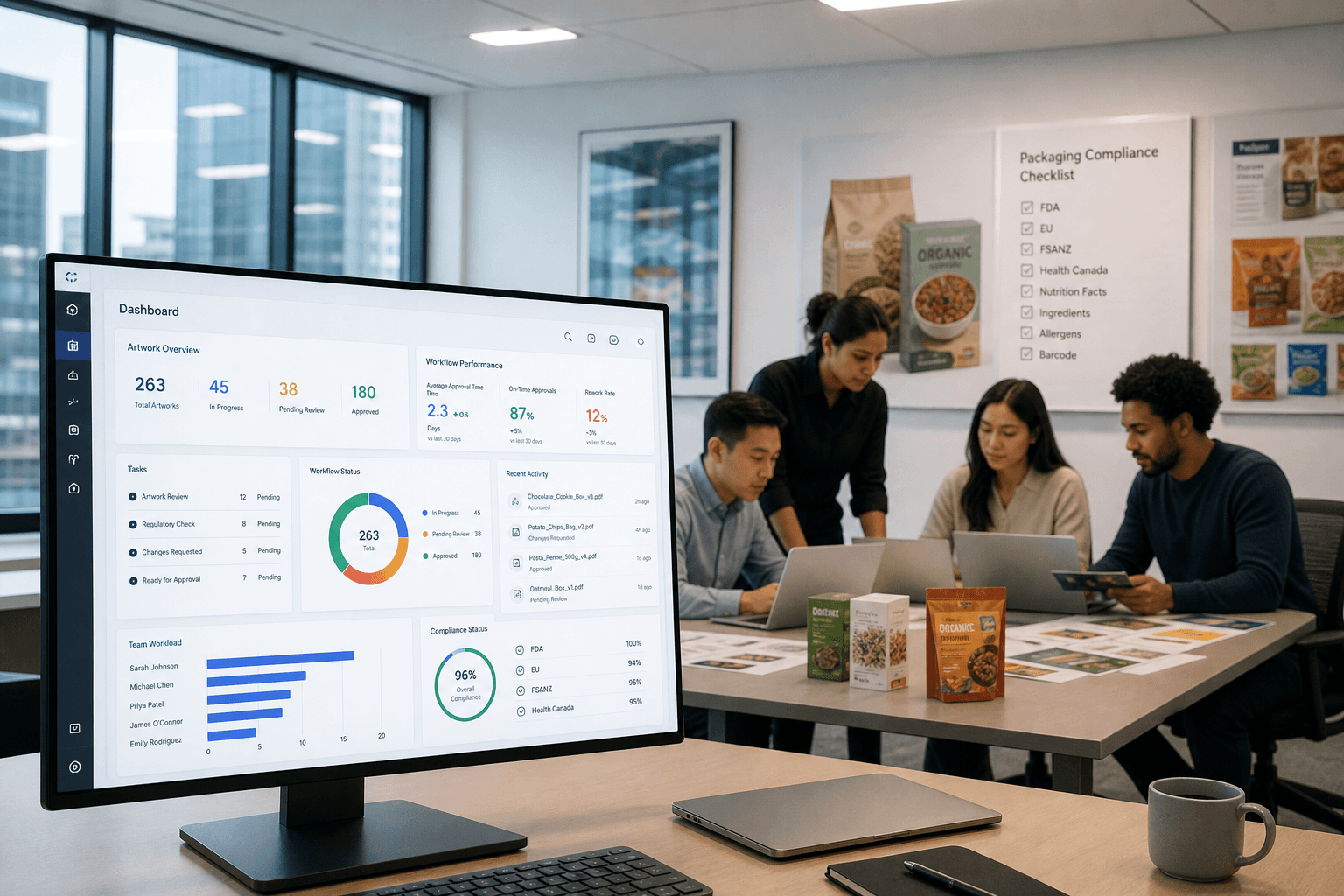
Every workflow action, approval, comment, and revision is recorded automatically, creating a complete history of packaging decisions. Teams can customize approval stages, manage reviewer responsibilities, monitor workflow performance through dashboards, and maintain visibility across internal and external stakeholders.

By connecting artwork reviews, workflow management, version control, and digital asset management within a single environment, Cway helps organizations create a more transparent and controlled packaging process.

Conclusion

EU food packaging compliance is not just about getting labeling content right.

It is about maintaining control over the entire packaging approval process.

As packaging portfolios grow and regulatory expectations increase, organizations need systems that provide traceability, accountability, and visibility at every stage of the artwork lifecycle.

The right artwork management platform helps transform compliance from a reactive exercise into a structured, repeatable process built into everyday operations.


FAQ


Core features of online proofing software every brand needs

Core features of online proofing software every brand needs

Looking to upgrade your review and approval process in 2026? In this article, we explore the top features of online proofing software that packaging,...

View Full Article
Best tools to track and manage packaging artwork accurately

Best tools to track and manage packaging artwork accurately

In this article, we’ll explore the top systems for packaging artwork traceability. From compliance to speed, learn how leading tools ensure every...

View Full Article
9 audit-ready features in artwork management systems

9 audit-ready features in artwork management systems

When regulatory auditors arrive at your door, your ability to answer their questions depends entirely on what your artwork management system has been...

View Full Article