
Global packaging design governance workflows in 2026
Running packaging design for a single market is complex. Running it across five, ten, or twenty markets—each with distinct regulations, languages,...
Running packaging operations across multiple markets means you're managing more than artwork files. You're coordinating regional requirements, approval hierarchies, and compliance documentation—all while trying to hit launch windows. Without the right governance controls, even small oversights can cascade into costly delays or compliance issues. That's where structured packaging design governance becomes essential.
Cway gives you the tools to standardize approvals, maintain audit trails, and protect brand integrity across all your packaging workflows. In this article, you'll find 9 practical governance controls that packaging and artwork operations managers can implement to bring order, visibility, and accountability to global design approvals.
When packaging artwork moves across borders and regulatory environments, the margin for error shrinks dramatically. We identified these 9 controls based on what matters most for artwork operations managers overseeing multi-market launches.
Governance starts with knowing where everything lives. When packaging files are scattered across shared drives, email threads, and local folders, it becomes nearly impossible to maintain control. A centralized repository establishes one authoritative location for all artwork, master files, and approved assets.
This single source of truth eliminates the risk of someone working from an outdated file. It also simplifies retrieval during audits when you need to prove which version went to print. According to a FloQast analysis, centralized storage is the foundation for defensible audit trails and faster evidence retrieval.
Cway consolidates your packaging assets in one secure platform. Every file has a clear history, and finding the right version takes seconds rather than hours. This means your packaging operations team spends less time searching and more time moving projects forward.
Not everyone needs access to everything. Role-based access control (RBAC) ensures that each person sees only what's relevant to their function. A designer accesses artwork files. A regulatory reviewer focuses on compliance documentation. A printer receives only final, approved files.
This control reduces risk by limiting who can make changes at each stage. It also supports separation of duties—a key expectation in compliance frameworks. When access is well-defined, you minimize accidental edits and unauthorized modifications.
Governance falls apart when no one knows who's supposed to act next. Structured workflows define exactly who reviews, in what order, and by when. Each artwork moves through a predictable sequence: design, brand review, regulatory check, final sign-off, release to print.
Cway automates this routing so projects don't stall waiting for someone to forward a file. Every stakeholder sees their tasks and deadlines. Cway's workflow automation replaces the guesswork with structure—so your packaging launches stay on schedule.
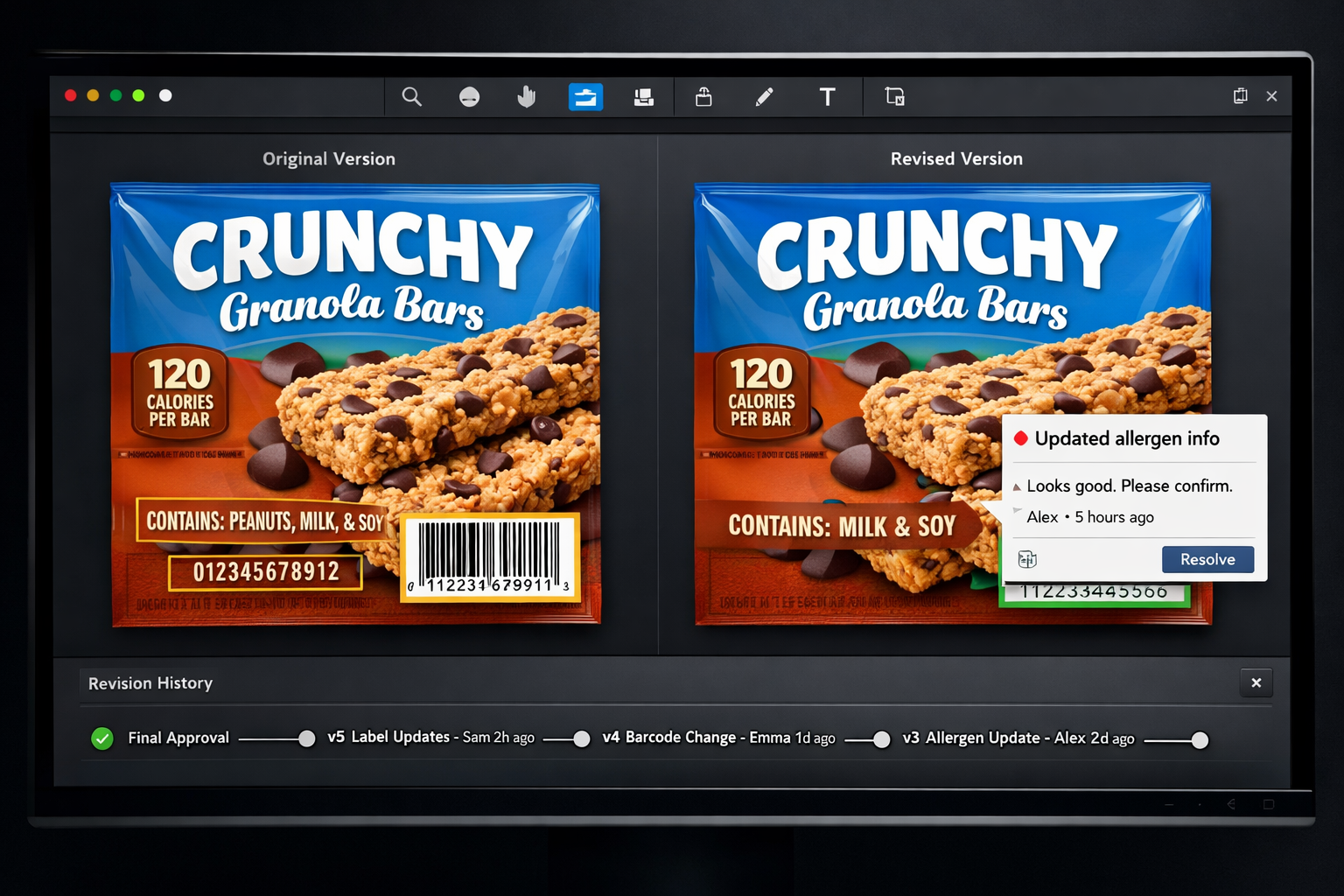
Packaging artwork goes through multiple revisions. Without robust version control, it's easy to lose track of what changed, when, and why. Visual comparison tools let reviewers see differences between versions instantly—whether it's a font shift, a color adjustment, or a regulatory statement update.
Cway's side-by-side comparison feature highlights changes automatically. This speeds up reviews and ensures that only intended modifications make it through. No more squinting at two PDFs trying to spot the difference.
When regulators or internal auditors ask what happened, you need answers. Audit trails capture every action: who uploaded a file, who approved it, who requested changes, and when each step occurred. This documentation proves that your process was followed.
For packaging teams in regulated industries, audit trails aren't optional—they're expected. Cway automatically logs every decision and modification, creating a complete record without additional effort from your team. Learn more about how to prepare for packaging compliance audits.
When approvals involve six or more stakeholders, accountability can blur. Governance requires knowing exactly who signed off, who flagged issues, and who has outstanding tasks. This control assigns clear responsibility at every stage.
Cway makes accountability visible. Each stakeholder sees their assigned tasks, and project managers can track who's holding up progress. This transparency encourages timely action and reduces finger-pointing when deadlines slip.
Packaging timelines are tight. When one reviewer misses a deadline, the entire launch can shift. Deadline enforcement mechanisms—automatic reminders, escalation rules, and SLA tracking—keep projects moving.
Cway sends notifications when deadlines approach and escalates overdue tasks to managers. This removes the need for project coordinators to manually chase stakeholders, freeing them to focus on more strategic work.
Packaging workflows involve external partners: design agencies, prepress studios, printers. These collaborators need access to relevant files without exposure to your entire system. Secure collaboration controls let you share precisely what's needed.
Cway's Collaborate feature enables context-rich file sharing with previews, comments, and controlled access. External partners can review and provide feedback in the same platform—no separate portals or email attachments required.
You can't improve what you don't measure. Analytics dashboards give packaging operations managers visibility into cycle times, bottlenecks, and team performance. This data supports continuous improvement and resource planning.
Cway's built-in analytics track metrics like average approval time, revision rounds per project, and on-time completion rates. These insights help you identify systemic issues and demonstrate the value of governance investments.
| Governance Control | Primary Benefit | Cway Support |
|---|---|---|
| Centralized asset repository | Single source of truth | ✓ |
| Role-based access controls | Risk reduction | ✓ |
| Structured approval workflows | Clear ownership | ✓ |
| Version control with visual comparison | Error prevention | ✓ |
| Audit trail documentation | Regulatory compliance | ✓ |
| Stakeholder accountability tracking | Responsibility clarity | ✓ |
| Deadline enforcement mechanisms | On-time delivery | ✓ |
| Secure external collaboration | Partner efficiency | ✓ |
| Analytics and reporting dashboards | Improvement insights | ✓ |
Individual controls are useful, but governance works when controls work together. An effective framework connects asset management, approval workflows, version control, and audit trails into one coherent system.
The framework should match your organizational reality. A pharmaceutical brand with strict FDA requirements needs different configurations than an FMCG company launching seasonal variants. Build governance that reflects your actual risk profile and regulatory environment.
Start with the controls that address your biggest pain points. If version confusion causes most of your delays, prioritize version control and visual comparison. If audit preparation takes weeks, focus on audit trail documentation first. Governance is iterative—you'll refine it over time.
Implementation starts with mapping your current process. Document how artwork moves from brief to print today, including all handoffs, review stages, and decision points. This baseline reveals where governance is weakest.
Next, prioritize based on risk and impact. Not all controls need to be implemented at once. Phase your rollout starting with the controls that address your most pressing issues. For many teams, structured workflows and version control deliver quick wins.
Finally, invest in adoption. Governance controls only work when people use them consistently. This means training, clear documentation, and leadership support. Platforms like Cway help by making the right way of working also the easiest way.
Cway brings all 9 governance controls together in one purpose-built platform for packaging and artwork operations. Instead of stitching together separate tools for asset storage, approvals, and project management, you get a unified environment designed for how packaging teams actually work.
Cway reduces approval cycles by automating routing and eliminating manual handoffs. Teams report up to 70% faster approval cycles and 40% fewer revision rounds after implementation. That's not incremental improvement—it's a fundamental shift in how packaging gets done.
Beyond speed, Cway delivers the auditability and transparency that regulated brands require. Every decision is logged, every version is tracked, and every approval is documented. When an auditor asks for evidence, you have it. Explore Cway's artwork approval features to see how governance becomes a natural part of your workflow.
Packaging design governance is the set of policies, processes, and controls that ensure artwork is created, reviewed, and approved consistently across an organization. It covers who can make changes, how approvals flow, and how decisions are documented. Cway helps you implement governance controls that protect brand integrity and support regulatory compliance.
Global brands face complexity from multiple markets, languages, and regulatory requirements. Governance controls bring order to this complexity by standardizing how artwork moves through approvals. Without them, inconsistencies, delays, and compliance gaps multiply. Cway gives global teams the structure they need to launch packaging accurately across every market.
Audit trails are documented records of every action taken during the artwork approval process—who did what, when, and why. They're essential for regulatory compliance and internal accountability. Cway automatically captures this information, making audit preparation straightforward.
Role-based access ensures people can only view and modify what's relevant to their function. A designer sees artwork files; a regulatory reviewer sees compliance documentation. This prevents unauthorized changes and supports separation of duties. Cway makes it easy to configure permissions that match your organizational structure.
Running packaging design for a single market is complex. Running it across five, ten, or twenty markets—each with distinct regulations, languages,...

Annotation and markup tools can make or break your packaging artwork approval process. When you're reviewing files that contain allergens, legal...
Food packaging compliance in the European Union is becoming increasingly complex. Brands must manage multilingual packaging, ingredient updates,...