2 min read

Smarter Artwork Proofreading: Methods, Data and Key Takeaways

Smarter Artwork Proofreading: Methods, Data and Key Takeaways
How Do You Proofread Artwork Today? Best Practices, Data and Lessons
4:38

A single packaging artwork can need input from six, eight, sometimes a dozen people across several companies. When everyone knows their role, that's a strength. When nobody does, it's the reason a two-week project takes two months.

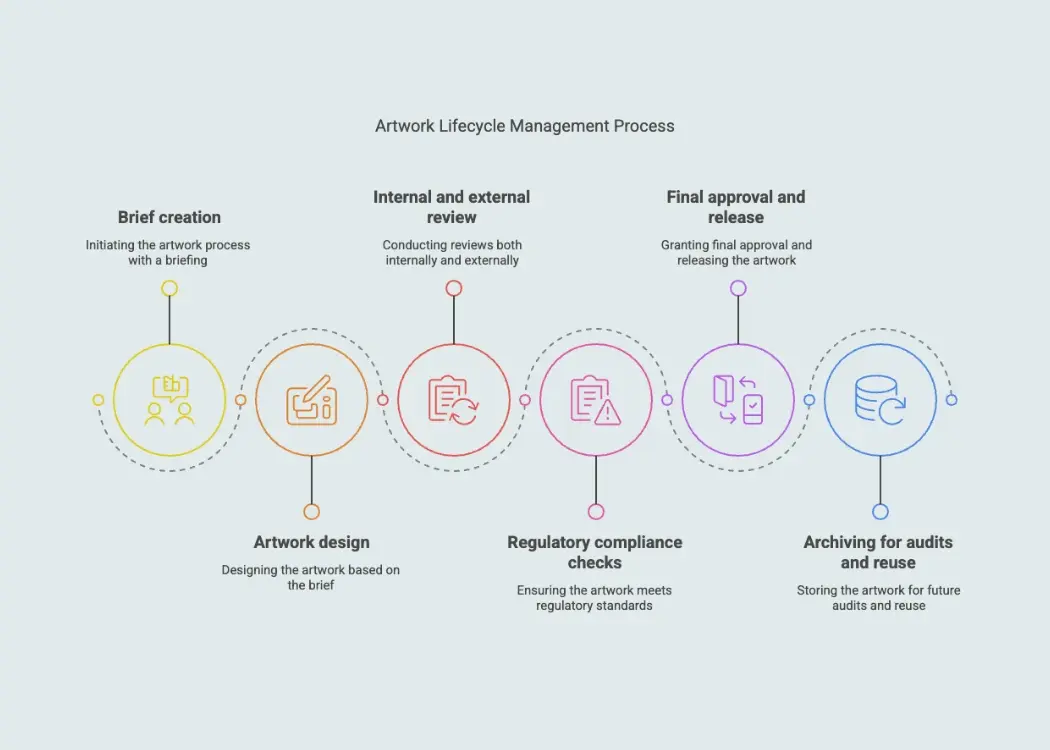
This article maps out who's typically involved in packaging artwork, what each role is responsible for, and a RACI matrix you can adapt. For background on the process these people work within, see this explainer on what artwork management is.

The usual cast

Brand / marketing

Owns the product and the shelf message. Defines what the pack should communicate and is usually the project's commercial owner.

Typical risk: late creative changes after content is locked.

Artwork / packaging project manager

Runs the project: briefs, timelines, reviewer coordination, version control and release to print.

Typical risk: acting as a messenger between people instead of owning a clear process.

Regulatory affairs

Checks mandatory information, claims, allergens and market-specific labeling rules.

Typical risk: being involved too late, after design is "finished".

Legal

Reviews trademarks, claims with legal exposure and competition or comparative statements.

Typical risk: unclear when legal review is needed, so it's either skipped or requested for everything.

R&D / product development / quality

Provides the formulation, ingredient list, nutrition values and technical product data.

Typical risk: recipe changes that never reach the artwork team.

Packaging technology / engineering

Owns the dieline, pack format and material specifications.

Typical risk: dieline updates not shared, so artwork is built on an old template.

Design agency / artwork studio

Creates the design and builds the artwork files.

Typical risk: working from unapproved or incomplete content.

Repro / prepress

Prepares print-ready files for the specific press, handles colour, trapping and technical checks.

Typical risk: receiving files with errors that should have been caught upstream.

Printer / converter

Prints the packaging and confirms that files meet press requirements.

Typical risk: problems discovered at press check, when changes are most expensive.

Supply chain / procurement

Plans print volumes, print slots and stock run-outs of old packaging.

Typical risk: print slot deadlines not visible to the artwork team.

RACI matrix for a packaging artwork project

R = Responsible (does the work) · A = Accountable (final decision) · C = Consulted (gives input) · I = Informed (kept up to date)


Activity

Brand Artwork PM Regulatory Legal R&D / Quality Packaging tech Agency Repro Printer
Initiate change / brief A R C C C C I I I
Provide approved product data I I C – A/R – I – –
Approve copy and claims C I A/R C C – I – –
Provide dieline and specs I I – – – A/R I C C
Create artwork C A – – – C R I –
Brand review A/R I – – – – C – –
Regulatory review I I A/R C C – – – –
Legal review (when needed) I I C A/R – – – – –
Technical / print review I I – – – C C R C
Final approval A R C C – – I I I
Release files to print I A/R – – – – I R I
Print and press check I C – – C C – C A/R


Adapt it to your organisation, but keep one rule: one A per activity. Two accountable people means nobody is.

Five practices that make stakeholder collaboration work

  1. Agree roles before the first proof. Put the reviewers and their scope in the brief, not in a reply-all email in round three.
  2. Give every reviewer a defined scope. Regulatory checks regulatory content, brand checks brand. Reviewers outside their scope add rounds without adding accuracy.
  3. Bring regulatory and packaging tech in early. Most late changes come from content or dieline issues that were knowable at the brief stage.
  4. Review the same file, in one place. When people annotate different copies, comments conflict and versions drift.
  5. Set response times. A review that has no deadline becomes the critical path.

How many reviewers is too many?

There's no universal number, but more reviewers doesn't automatically mean more accuracy. Each extra person adds coordination time, and overlapping scopes create conflicting comments. A useful test is to ask, for each reviewer: what would go wrong if this person didn't review? If the answer is "nothing specific", they should probably be informed rather than consulted.

Final thought

Packaging artwork is a team sport played across company borders. Tools help, but clarity about who does what is what turns a crowd of reviewers into a process. Start with the RACI, put it in your brief template, and revisit it after every project that ran late.

Why artwork lifecycle management is essential in 2025

Why artwork lifecycle management is essential in 2025

Explore why artwork lifecycle management is a must-have in 2025 to improve efficiency, stay compliant, and reduce costly packaging errors.

View Full Article
9 controls for global packaging design governance

9 controls for global packaging design governance

Discover 9 governance controls for global packaging design approvals. Cway helps you standardize workflows with audit trails and role-based access.

View Full Article
12 multi-market packaging risks and how to prevent them

12 multi-market packaging risks and how to prevent them

Discover 12 common multi-market packaging risks and how centralized workflows help reduce errors, delays, and compliance issues.

View Full Article