Managing 3,000 artworks a year: how FMCG brands stay in control
Three thousand packaging artworks a year. That's not an edge case — it's a realistic volume for any mid-to-large FMCG brand managing multiple product...

Fast-growing brands are built on speed. Speed to market. Speed of launching new SKUs. Speed of entering new regions. At first, this momentum feels like pure progress.
Until one day it doesn’t.
Behind every new product is packaging. Behind every new market is a new set of rules. What used to be a single artwork file becomes dozens of versions: different languages, different legal requirements, different formats, different adaptations for channels and retailers..
And suddenly, your team is no longer creating — it’s chasing.
Chasing approvals.
Chasing the latest version.
Chasing agencies.
Chasing clarity.
In the beginning, everything works.
You approve designs over email. Store files in folders. Maybe track progress in spreadsheets. It’s messy, but manageable — because the scale is small.
But growth doesn’t just add volume — it multiplies complexity.
A new product line isn’t just “+1 project.”
It’s:
Each one with its own lifecycle.
Now multiply that by every launch, every region, every partner.
What you get isn’t growth.
You get fragmentation.
At some stage, something subtle but dangerous happens:
You lose visibility.
Not completely. Just enough to create risk.
And the worst part?
No single person can confidently answer a simple question:
“Where does this artwork stand right now?”
That’s not a workflow issue.
That’s a business risk.
Because at scale, one wrong file in print isn’t a small mistake — it’s lost money, delayed launches, compliance issues, and damaged relationships with retailers.
To handle the workload, brands bring in more partners: design agencies, adaptation studios, printers, regulatory experts.
But every new stakeholder adds another communication layer.
More emails.
More file exchanges.
More assumptions.
And paradoxically — less control.
You might think you’ve delegated execution.
But in reality, you’ve also distributed ownership of critical assets.
Which leads to situations like:
At this point, the process isn’t just inefficient.
It’s fragile.
There’s a pattern here that every business has already lived through.
In the early days, you can manage accounting in a notebook.
Or in a simple spreadsheet.
Or even just “in your head.”
But as soon as the company grows, that approach collapses.
Not because people got worse —
but because the system didn’t scale.
So what do companies do?
They don’t hire ten more people to manually track numbers.
They implement dedicated financial software.
Because finance is too critical to run on chaos.
Now ask yourself:
Why is artwork — the thing that ends up on your product, on the shelf, in the hands of customers — still managed like early-stage accounting?
Artwork is no longer just a design task.
It’s a complex, multi-stage, multi-stakeholder operational process.
And like any critical process at scale, it needs dedicated infrastructure.
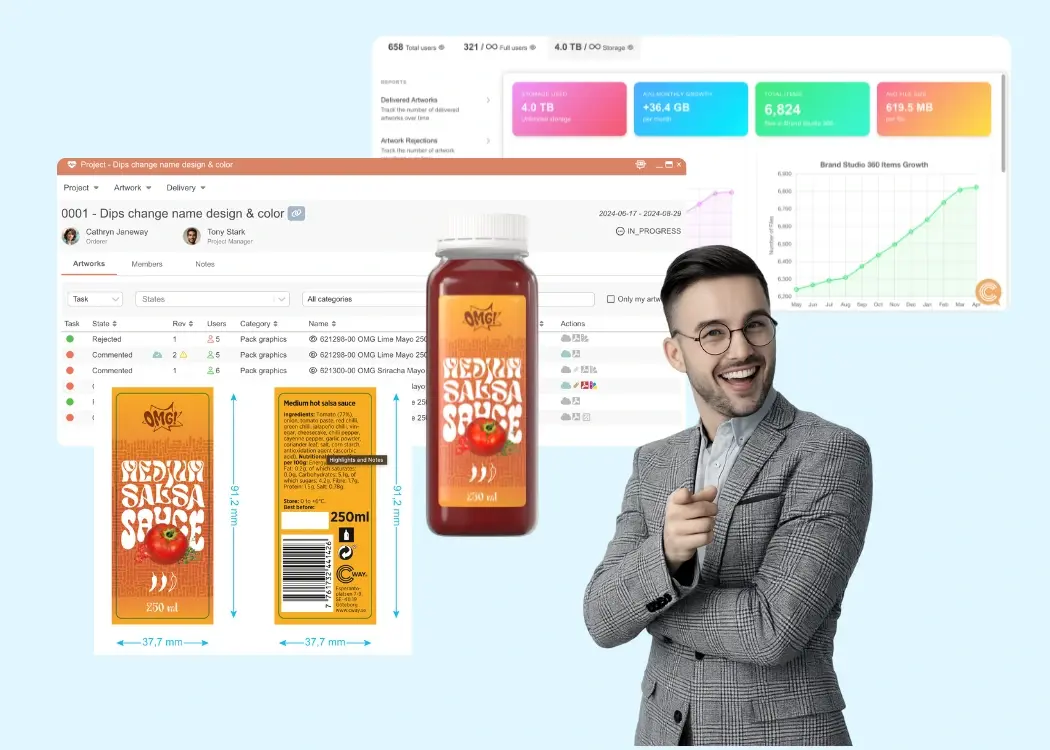
This is where solutions like Cway software come in — not as “another tool,” but as a system built specifically for FMCG packaging workflows.
Instead of disconnected emails, folders, and approvals, you get:
In other words:
Visibility. Control. Confidence.
Without a system, your team spends its time reacting:
fixing mistakes, clarifying versions, chasing updates.
With the right system, the process becomes predictable.
You know:
And most importantly — you eliminate costly errors before they happen.
If you don’t know where your artwork stands, it’s not because your team isn’t working hard enough.
It’s because you’ve outgrown the way you manage the process.
Just like accounting needed its own software when the business scaled,
artwork management requires its own system once complexity takes over.
Because at the end of the day, growth without control isn’t growth. It’s risk.
Three thousand packaging artworks a year. That's not an edge case — it's a realistic volume for any mid-to-large FMCG brand managing multiple product...
In this article, we’ll explore why packaging compliance software is a must-have for modern brands. Learn how it helps meet packaging standards,...
Artificial intelligence is no longer a futuristic idea in the world of graphic production. It has rapidly matured into a practical, accessible, and...