PPWR Compliance:

What It Actually Means for Packaging Approval

PPWR packaging compliance

Last updated: September 7, 2026  · Reviewed by Collabra's packaging compliance experts

Quick summary: PPWR (Regulation (EU) 2025/40) is now in force, with the core framework applying from 12 August 2026. It affects any company placing packaged goods on the EU market. For teams managing packaging artwork, it means a multi-year wave of labeling, material, and documentation updates — often across hundreds of SKUs and markets. This page breaks down the timeline, the impact, and what to check in your own process.

This is not legal advice. For compliance decisions, consult your legal or regulatory team — this page is meant to help you understand the operational scale of what's ahead.

1. What Is PPWR (Packaging and Packaging Waste Regulation)?


PPWR (Regulation (EU) 2025/40) is the EU's new packaging law, effective from 12 August 2026, that sets binding rules on packaging design, labeling, recyclability, and reuse across all EU member states.

It replaces the previous Packaging and Packaging Waste Directive. Unlike a directive, PPWR is a regulation — it applies directly and uniformly across all member states, rather than being transposed into national law with local variations.

It covers the entire lifecycle of packaging: design, production, market placement, labeling, reuse, and end-of-life recycling.

2. PPWR Timeline: The Key Dates to Know

One of the easiest ways to understand PPWR is to stop thinking about it as one deadline and start thinking about it as a pipeline of regulatory changes.

Date What Happens Legal Basis Potential Impact on Packaging Teams
11 Feb 2025 PPWR enters into force Art. 71 Companies begin preparing for implementation
12 Aug 2026 PPWR generally starts applying; substance restrictions take effect Art. 71; Art. 5 First applicable requirements and restrictions come into effect
12 Feb 2027 Commission must issue implementing/delegated acts and standardisation mandates; Member States must set penalties Art. 12(6)–(7); Art. 24; Art. 68 More detailed guidance, standards and supporting rules become available
12 Feb 2028 Recyclability criteria and empty-space/minimisation methodology are due Art. 6; Art. 24 Packaging specifications may need to be reassessed
12 Aug 2028* Harmonised material-composition labelling applies Art. 12(1) Potential artwork and labelling updates across SKUs and markets
12 Feb 2029* Reusable packaging labelling applies Art. 12(2) New artwork/data requirements for relevant packaging
1 Jan 2030 Minimum recyclability grade, recycled-content targets, empty-space cap and single-use restrictions take effect Art. 6; Art. 7; Art. 24; Annex V Significant potential impact on packaging design and specifications
2030–2035 Additional recyclability, reuse and recycled-content targets apply Art. 7; Art. 29 Ongoing packaging redesign and approval activity
2040 Further, more ambitious packaging waste and reuse targets apply Art. 7; Art. 29 Long-term packaging portfolio transformation

Article references are provided for orientation and reflect our reading of Regulation (EU) 2025/40 at the time of publication. Some dates depend on Commission implementing or delegated acts not yet adopted and may shift. This is not legal advice — consult the full regulation text (eur-lex.europa.eu) or your legal team for definitive guidance.

The exact applicability of individual requirements can depend on implementing or delegated acts and the specific packaging format. For example, the regulation provides for harmonised packaging material labelling from 12 August 2028 or 24 months after relevant implementing acts, whichever is later.

Similarly, important recyclability and packaging-waste prevention requirements are phased towards 2030 and beyond.

The operational takeaway: PPWR is not one project with one go-live date. It is a rolling programme of packaging changes.


3. Who Does PPWR Apply To?

A common misconception is that PPWR is mainly an EU-based company issue.

It isn't.

The regulation applies to packaging and packaged products placed on the EU market, with specific responsibilities depending on the role of the economic operator — including manufacturers, importers and other actors in the supply chain.

So if your company:

  • sells packaged products in the EU;
  • imports packaged products into the EU;
  • manufactures packaging for products sold in the EU; or
  • manages a portfolio of packaging placed on the EU market,

PPWR can become part of your compliance and packaging-change workflow.

The precise legal obligations depend on your role and the type of packaging involved. But operationally, the message is simple:

If your packaging is changing because of PPWR, your artwork and approval process will have to change with it.

20+ Years Managing Packaging Approval at Scale

Collabra's packaging experts have run artwork approval for some of the largest names in the industry — across hundreds of SKUs and thousands of files. See what they're seeing across the market right now.


4. What Does PPWR Mean for Packaging Artwork and Approval Workflows?

his is where the regulation moves from legal text into day-to-day operations.

PPWR is not simply about creating a compliance document and filing it away.

Many requirements can ultimately trigger changes to the physical packaging — and therefore to the artwork that represents that packaging.

4.1. Changes in labelling can mean new artwork versions

PPWR introduces harmonised labelling requirements intended to provide consumers with information such as packaging material composition and, for reusable packaging, information about reuse.

For an artwork team, that can translate into:

regulatory change → artwork change → review → approval → production

And that sequence may need to happen across:

  • multiple SKUs;
  • multiple pack sizes;
  • multiple markets;
  • multiple languages;
  • multiple packaging components.

A regulatory change that looks small on paper can therefore create hundreds of individual approval tasks.

4.2. Recyclability requirements can reach beyond the artwork

PPWR includes requirements around recyclable packaging and packaging design. Some of these requirements concern the packaging itself, not just what is printed on it.

That means a packaging change may involve collaboration between:

  • Regulatory
  • Packaging Development
  • Sustainability
  • Procurement
  • Manufacturing
  • Printers and suppliers
  • Marketing
  • Artwork teams

A change in substrate, material composition, component structure or packaging format can then create a corresponding artwork change.

The approval process therefore needs to connect what changed in the packaging specification with what changed in the artwork.

4.3. Compliance documentation increases the importance of traceability

PPWR introduces formal conformity assessment and documentation requirements.

Manufacturers must prepare technical documentation, and where applicable draw up an EU Declaration of Conformity. The declaration must be continuously updated, while technical documentation and declarations must be retained for five years for single-use packaging and ten years for reusable packaging.

The regulation also requires packaging to be identifiable through a type, batch, serial number or another identification element, where applicable.

For organisations managing hundreds or thousands of packaging assets, this puts a premium on:

traceability + version control + documented approvals.

You need to know not only which artwork is current, but also:

  • which version was approved;
  • when it was approved;
  • for which market;
  • for which SKU;
  • against which requirements;
  • what changed from the previous version;
  • who reviewed it;
  • and which supporting documentation relates to it.

4.4. PPWR creates a continuous change cycle — not a one-off project

This may be the biggest operational difference.

Because PPWR requirements are phased over several years, packaging teams should not expect one large “PPWR artwork update” followed by business as usual.

Instead, the likely pattern is:

new requirement → impact assessment → packaging change → artwork change → review → approval → implementation → next requirement

And then the cycle repeats.

For global companies, that cycle becomes even more complex because different products, markets and packaging formats may be affected at different times.


5. Why Manual Approval Processes Struggle Under PPWR

Email threads, shared drives, and spreadsheets can handle artwork approval at a small scale — a handful of SKUs, a few markets, occasional revisions.

PPWR changes the math. When the number of required updates multiplies across SKUs, markets, and staggered deadlines, the coordination overhead multiplies with it. Version control becomes harder to track. Sign-off chains get longer. And producing a clean audit trail for a Declaration of Conformity becomes a manual reconstruction project rather than something you can pull on demand.

This is usually the point where teams start asking a different question — not "how do we comply," but "how do we make sure our process can handle this volume at all."


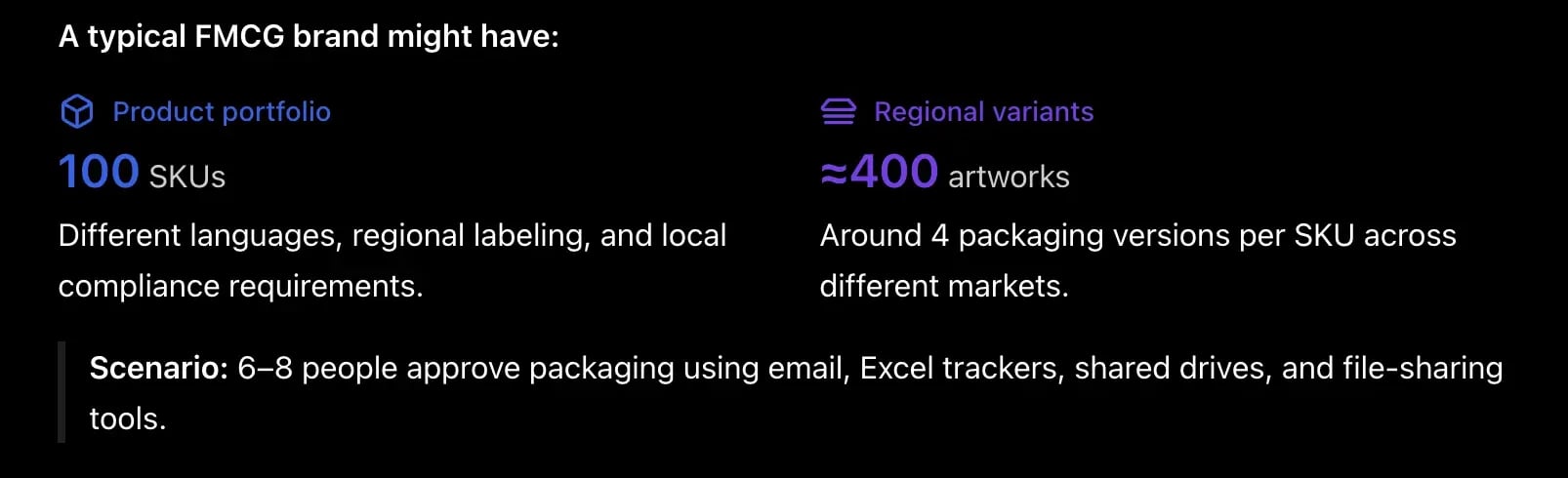
typical FMCG brand PPWR reality

A Mid-Sized Brand, By the Numbers

  • 100 SKUs, sold across ~4 regional variants on average
  • ~400 individual artwork files in scope for PPWR labelling updates
  • A team of 6-8 people manages approval
  • Process: email threads, spreadsheets, files on shared drives

Multiply SKUs by regional label variants, and the real scope of work is roughly 4x larger than the SKU count suggests — a pattern many teams underestimate until they're mid-rollout.

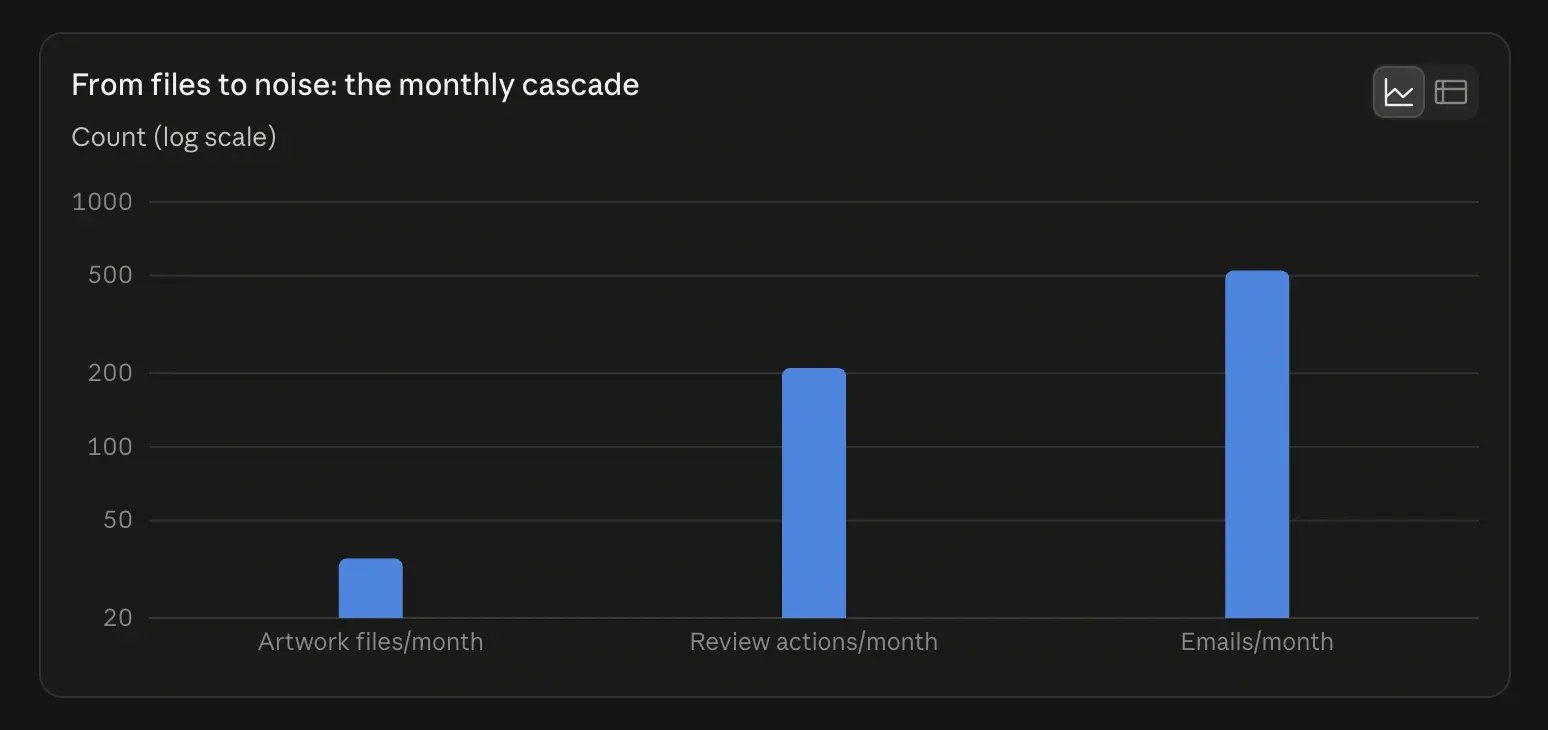
PPWR compliance workload

Racing a Moving Target

Even with a reasonable 12-month runway before the labelling deadline, this team would need to move roughly 35 artwork files a month through approval — over twice its normal pace.

One File, Six Rounds, Endless Emails

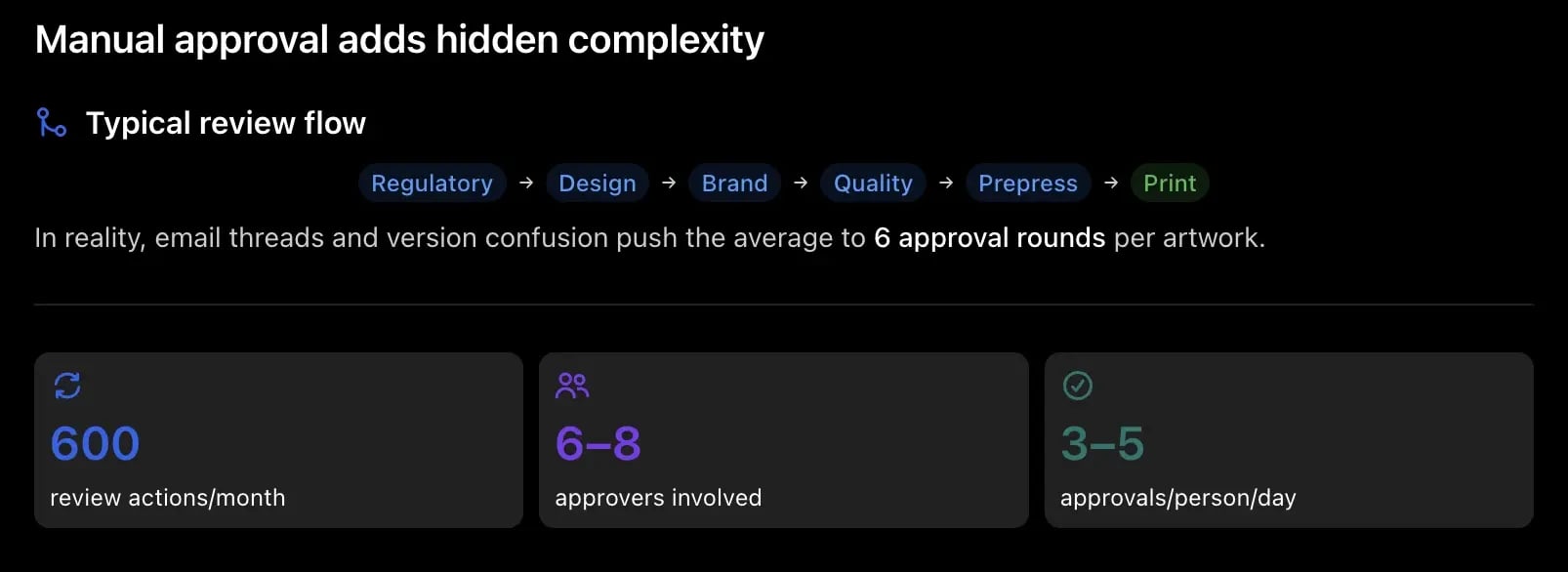
Each artwork typically goes through 6 approval rounds before it's print-ready. At 35 files a month, that's over 200 review actions — and, in an email-based process, several hundred emails just to track status.

PPWR manual approval hidden complexity

It's Not Just Volume — It's the Audit Trail

With files and feedback scattered across email, spreadsheets, and shared drives, reconstructing a clean, versioned history for a Declaration of Conformity becomes a manual project of its own — not something you can produce on demand.

6. PPWR Readiness Self-Check

Before diving deeper, it's worth asking:

1. Do you know exactly how many SKUs will require packaging updates?

Can you identify the affected products by market, packaging component and regulatory deadline?

2. Can you see approval status across every EU market?

Do you have one reliable view showing what is approved, in review, rejected or still waiting to start?

3. Can you identify the current approved artwork immediately?

If someone asks for the latest approved version today, can your team find it without searching through email threads and shared folders?

4. Can you trace every approval decision?

Can you see who approved an artwork, when they approved it and what version they approved?

5. Can you connect artwork changes with regulatory changes?

If a packaging requirement changes, can you identify which artwork versions and SKUs are affected?

6. Can you retrieve supporting compliance documentation quickly?

PPWR requires technical documentation and, where applicable, EU Declarations of Conformity to be maintained and kept available for defined periods.

7. Can your process handle several waves of changes over the next few years?

If the answer is “not without adding a lot of manual work,” PPWR may expose a process problem rather than simply a compliance problem.

The important thing to remember is that PPWR does not only change what packaging needs to look like.

It can change how organisations need to manage packaging changes.

For companies with large packaging portfolios, compliance increasingly depends on the ability to coordinate information across regulatory, artwork, packaging, manufacturing and commercial teams.

That makes the packaging artwork approval process part of the compliance infrastructure.

A robust process should make it possible to answer three questions at any moment:

What changed?

Which packaging is affected?

Where are we in the approval and implementation process?

When those answers are easy to find, regulatory change becomes manageable.

When they are buried across emails, spreadsheets and disconnected systems, every new requirement creates another operational bottleneck.


7. What to Do Next

PPWR is already applying. And because many requirements are phased over the coming years, the organisations that prepare best are unlikely to be the ones that simply react fastest to each new deadline.

They will be the ones that build a packaging approval process capable of handling continuous regulatory change at scale.

That means having clear ownership, reliable version control, transparent approval status and a complete audit trail — across SKUs, markets and packaging components.

If your team is reviewing its packaging approval process in preparation for PPWR, Cway Software can help you assess where manual workflows create unnecessary risk and workload.

Start a free trial to see how a structured approval workflow can help your team manage packaging artwork changes more efficiently.

And if you need a closer look at your current process, book a Collabra Expert Review to identify practical opportunities to improve your artwork approval workflow.



See How Cway Handles High-Volume Artwork Approval

Built to replace email threads and spreadsheets with a structured, auditable approval workflow —

designed for teams managing hundreds of SKUs across multiple markets.


Book a Personalized Cway Demo

FAQ