9 min read

How to manage global FMCG packaging variants

How to manage global FMCG packaging variants
19:45

If you sell FMCG products in more than one country, you already know that packaging artwork is never "one and done." Each market brings its own labeling laws, claims restrictions, and language requirements. A product that flies off the shelves in Germany may need entirely different packaging text—and regulatory approvals—before it can ship to the US or Brazil.

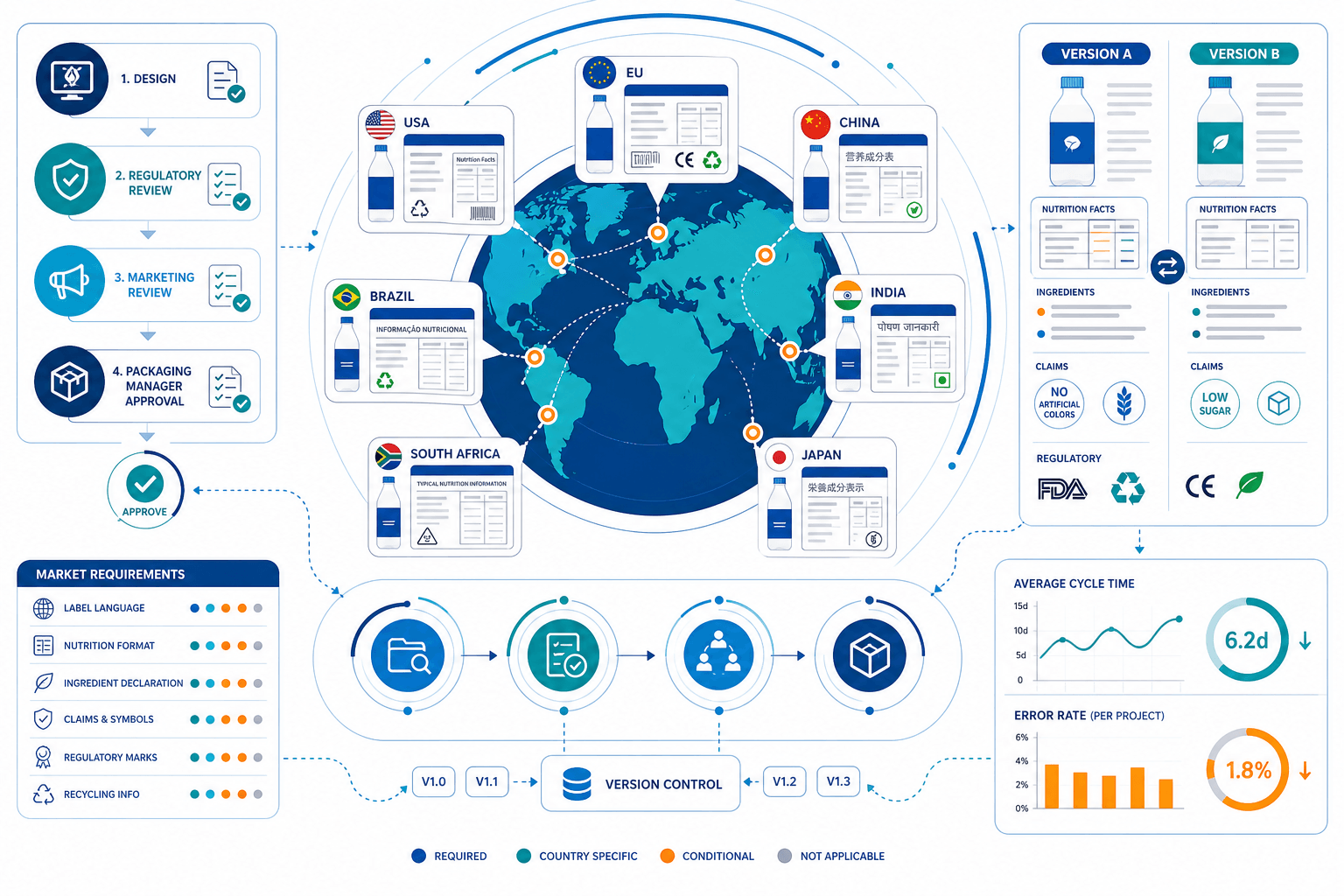
Managing these global packaging variants without a structured process leads to delays, compliance gaps, and costly reprints. This guide walks you through everything you need to know to control local labeling, claims approval, and market-specific variants through one auditable workflow. Cway helps packaging teams centralize this complexity into a single platform, giving you full visibility and control across every market you operate in.

Whether you have 50 SKUs or 5,000, the principles here apply. You will learn how to set up governance frameworks, structure approval workflows, and maintain audit-ready documentation that satisfies regulators in any region.

Key Takeaways: How to Manage Global FMCG Packaging Variants

  • Global packaging variants require structured workflows that account for local labeling laws, claims regulations, and language requirements in each market.
  • Centralizing all packaging artwork and approvals in one platform eliminates version confusion and reduces compliance risks across multiple regions.
  • Claims approval processes must include regulatory, legal, and marketing stakeholders with documented sign-offs for audit readiness.
  • Cway enables FMCG teams to manage packaging variants, approvals, and compliance documentation in a single auditable system.
  • Version control with visual comparison tools helps catch labeling errors before artwork goes to print, preventing costly recalls.

What Are Global FMCG Packaging Variants?

Global FMCG packaging variants are market-specific versions of the same product's packaging. These variants exist because different countries have different requirements for what must appear on product labels, how claims can be worded, and which languages must be used.

For example, a single breakfast cereal brand might have 15 different packaging variants across Europe alone. Each variant shares the same brand identity and product formulation, but the label text, nutritional information format, and marketing claims differ based on local regulations.

Managing these variants becomes increasingly complex as your product portfolio grows. A brand with 200 SKUs selling in 20 markets could easily have 4,000 or more unique packaging files to track, version, and keep compliant.

Why Do Packaging Variants Exist?

Packaging variants exist primarily due to regulatory differences between markets. Food and beverage products sold in the EU must comply with the EU Food Information to Consumers Regulation (FIC), while the same products sold in the US fall under FDA labeling requirements.

Beyond regulatory compliance, variants also exist for commercial reasons. Marketing teams may want different imagery or promotional messaging for specific markets. Retailers in certain regions may require specific barcode formats or shelf-ready packaging configurations.

Language is another major driver. A product sold in Belgium may need packaging in Dutch, French, and German. A product sold in Canada requires both English and French. These multilingual requirements multiply the number of unique files your team must manage.

The Core Challenges of Managing Global Packaging Variants

Managing packaging variants across multiple markets creates several interconnected challenges. Understanding these challenges is the first step toward building a workflow that addresses them systematically.

Regulatory Complexity Across Markets

Each market you sell in has its own regulatory body with specific requirements. The FDA in the United States, EFSA in Europe, ANVISA in Brazil, and TGA in Australia all have different rules for what must appear on packaging and how claims can be substantiated.

These regulations change frequently. A claim that was compliant last year may require updated substantiation or rewording today. Keeping track of regulatory changes across 20+ markets requires dedicated resources and constant vigilance.

Version Control Across High SKU Counts

When you multiply products by markets by languages, the number of unique packaging files grows exponentially. A mid-sized FMCG brand might have 10,000 active packaging files at any given time.

Without proper version control, teams end up working on outdated files. An error that was corrected three revision cycles ago reappears because someone grabbed the wrong file. These version issues account for a significant percentage of packaging errors that lead to reprints.

Stakeholder Coordination and Approval Bottlenecks

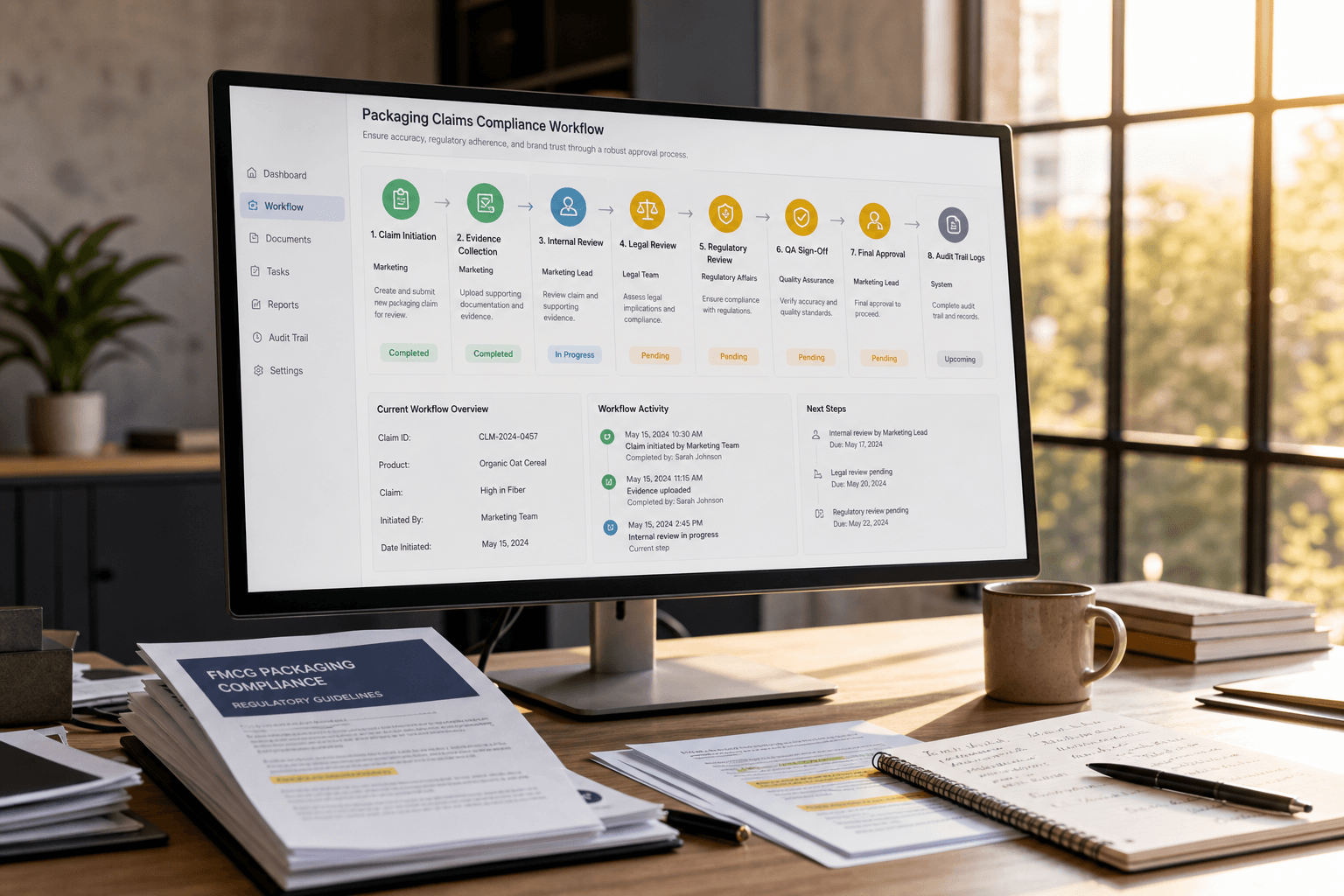
Getting packaging artwork approved typically requires sign-off from multiple stakeholders: brand managers, regulatory affairs specialists, legal teams, quality assurance, and sometimes external agencies or local market contacts.

Coordinating these approvals across time zones and departments creates bottlenecks. One delayed reviewer can hold up an entire product launch. Without visibility into where approvals are stalled, project managers spend valuable time chasing updates instead of moving work forward.

Audit Trail and Documentation Requirements

Regulators expect you to demonstrate that proper approval processes were followed. If a compliance issue arises, you need to show who approved what, when, and based on what information.

Maintaining this audit trail across thousands of files and dozens of markets becomes unmanageable without a dedicated system. 

How to Build a Global Packaging Variant Workflow

Building an effective workflow for global packaging variants requires addressing each of the core challenges systematically. The goal is to create a repeatable process that scales as your product portfolio and market presence grow.

Step 1: Establish a Single Source of Truth

Every packaging workflow starts with centralizing your files. All packaging artwork, master files, and approved variants need to live in one location where every stakeholder can access the correct version.

This central repository should support the file types your team uses: PDFs, Adobe Illustrator files, Photoshop files, and increasingly, 3D packaging renders. It should also handle large file sizes without forcing your team to compress or split files.

Cway's platform serves as this single source of truth, storing all packaging files with automatic versioning and full preview support. When someone opens a file, they know they are working on the current approved version—not something from three revisions ago.

Step 2: Define Market-Specific Compliance Requirements

Before artwork moves through your workflow, you need clear documentation of what each market requires. This includes mandatory label elements, restricted claims, required languages, and any market-specific formatting rules.

Create a compliance checklist for each market you sell in. This checklist becomes the reference point for regulatory reviewers and helps catch issues before they become costly errors. The US packaging and labeling requirements guide from Meyers demonstrates the level of detail these checklists should include.

Your compliance requirements should be version-controlled just like your artwork. 

Step 3: Structure Your Approval Workflow

Design an approval workflow that routes artwork to the right reviewers in the right sequence. Most global FMCG brands need at least three types of reviewers: creative/brand reviewers, regulatory/legal reviewers, and quality assurance reviewers.

The sequence matters. Brand reviewers should sign off on visual elements before regulatory reviewers check compliance. This prevents rework when regulatory changes trigger creative revisions that then need another brand review.

Step 4: Implement Role-Based Permissions

Not everyone needs access to everything. A regulatory affairs manager in Germany does not need editing access to artwork files for the Brazilian market. A packaging designer does not need approval authority for regulatory sign-off.

Role-based permissions reduce risk by ensuring only authorized individuals can approve or modify files. They also simplify the user experience—each person sees only what they need to see, reducing confusion and speeding up their work.

Step 5: Enable Visual Comparison and Annotation

Packaging changes between variants are often subtle: a slightly different ingredient list, a modified claim, a translated marketing message. Catching these differences requires visual comparison tools that highlight exactly what changed between versions.

Side-by-side comparison views let reviewers spot differences quickly. Overlay comparisons can reveal even single-character changes that might otherwise slip through. Cway's integrated viewer includes markup and comparison tools that make variant review faster and more accurate.

Annotation tools allow reviewers to pinpoint issues directly on the artwork. Instead of describing "the text in the upper right corner," a reviewer can drop a pin exactly where the problem is and add their comment. This precision reduces back-and-forth and ensures corrections happen in the right location.

Step 6: Maintain Complete Audit Trails

Every action in your packaging workflow should be logged: who uploaded a file, who made changes, who approved what version, and when each action occurred. This audit trail becomes your defense during regulatory inspections and your source of truth when questions arise.

Audit trails should be immutable. Once an action is recorded, it cannot be deleted or modified. This immutability is what gives the audit trail its value—it represents an accurate historical record of your packaging process.

Cway automatically logs all activity with timestamps and user identification. When auditors request documentation of your approval process for a specific product variant, you can generate a complete history in minutes rather than days.

Version Control Strategies for Global Packaging

Version control is the backbone of effective packaging management. Without it, teams waste time working on outdated files, errors reappear after being corrected, and audit trails become unreliable.

Establishing Clear Naming Conventions

Consistent file naming makes it easier to identify the correct version and understand what each file contains. Your naming convention should include the product identifier, market code, language, and version number at minimum.

For example: SKU12345_US_EN_v3.2 tells you immediately that this is the US English variant in its third major version, second minor revision. Enforce naming conventions automatically through your workflow system to prevent inconsistencies.

Document your naming convention and ensure all team members understand it. When new team members join or external partners contribute to artwork, the convention is a common language for identifying files.

Automatic Versioning and Change Tracking

Manual version tracking invites errors. Automatic versioning creates a new version number each time a file is uploaded or modified, maintaining a complete history without relying on human diligence.

Change tracking should capture not just that a change was made, but what changed and who made it. Detailed change logs help reviewers understand exactly what is new in each version and help troubleshoot when issues arise.

Cway's auto-versioning with visual comparison lets your team see exactly what changed between any two versions. This capability is particularly valuable for packaging variants where changes may be subtle but compliance-critical.

Managing Master Files and Derived Variants

Most global packaging follows a master-variant structure. A master file contains the core brand elements and layout. Variants are derived from this master with market-specific modifications.

When the master changes—perhaps due to a brand refresh or formula modification—all variants need updating. Your workflow should track these relationships so you can identify all affected variants when a master file changes.

Establish clear rules about what can change in a variant versus what must come from the master. Brand colors, logos, and core design elements typically remain controlled by the master. Market-specific text, claims, and regulatory information live in the variant.

Integrating Packaging Workflows With Existing Systems

Your packaging workflow does not exist in isolation. It connects to product information management, enterprise resource planning, digital asset management, and production systems. Effective integration reduces data entry, prevents errors, and speeds up time-to-market.

Product Information Management (PIM) Integration

PIM systems hold the master product data that appears on packaging: ingredient lists, nutrition information, allergen statements, and product descriptions. Integrating your packaging workflow with PIM ensures artwork reflects accurate, current product data.

When product information changes in PIM, your packaging workflow should flag affected artwork for update. This integration prevents the common problem of packaging that does not match actual product formulations.

ERP and Production System Integration

Production systems need print-ready files delivered in specific formats with specific naming conventions. Integrating your packaging workflow with production systems automates this handoff and reduces manual file preparation.

Barcode verification is a critical integration point. Your workflow should validate barcodes against the ERP system to ensure the correct product code appears on each variant. Barcode errors cause significant downstream problems in retail and distribution.

Digital Asset Management Integration

Marketing teams often need access to packaging imagery for campaigns, websites, and sales materials. Integrating packaging workflows with broader digital asset management ensures marketing can find and use approved packaging visuals without duplicating files.

Cway combines media storage, versioning, and task tracking in one platform, reducing the need for multiple separate systems. This consolidation simplifies your technology stack and eliminates gaps where files and approval records can get lost.

Common Mistakes to Avoid When Managing Global Packaging Variants

Learning from others' mistakes saves time and prevents costly errors. Here are the most common pitfalls FMCG teams encounter when managing global packaging variants.

Treating All Markets the Same

Assuming what works in one market works in all markets leads to compliance failures. Each market has unique requirements, and generic approaches create gaps that regulators will find.

Invest in understanding each market's specific requirements. Build relationships with local regulatory experts who can alert you to upcoming changes and interpret ambiguous requirements.

Underestimating Translation Complexity

Translation is not simply swapping words from one language to another. Legal terminology, regulatory phrases, and marketing claims all require specialized translation knowledge.

Use translators with experience in FMCG packaging and regulatory language. Build in native-speaker review for each market, especially for allergen statements and health claims where errors have serious consequences.

Neglecting Audit Documentation

In the rush to meet launch deadlines, teams sometimes skip documentation steps. This creates risk during regulatory inspections and makes it difficult to investigate when issues arise.

Build documentation into your workflow so it happens automatically. When approvals require attached notes and evidence, reviewers cannot skip the documentation step. Cway's audit trail functionality captures this documentation automatically, reducing manual effort while ensuring completeness.

Siloing Packaging From Other Business Functions

Packaging does not exist in isolation. It connects to formulation, marketing, sales, production, and logistics. Siloed teams create disconnects where packaging does not reflect actual product reality.

Build cross-functional visibility into your workflow. When formulation changes, packaging teams should be notified automatically. When packaging timelines slip, production planning should be updated. This integration prevents surprises and enables proactive problem-solving.

The Future of Global Packaging Management

Packaging management continues to evolve as regulations change, technology advances, and sustainability becomes increasingly important. Preparing for these changes positions your team for continued success.

Increasing Regulatory Complexity

Regulations continue to proliferate and become more detailed. Front-of-pack labeling requirements are expanding globally. Sustainability claims face increasing scrutiny. Digital labeling through QR codes introduces new compliance considerations.

Build flexibility into your workflow to accommodate new requirements without major restructuring. Systems that adapt to changing regulations will serve you better than rigid processes designed for today's rules.

Digital and Smart Packaging

QR codes, NFC chips, and augmented reality are adding digital layers to physical packaging. These technologies enable richer consumer engagement but also create new content to manage and approve.

Your packaging workflow should accommodate these digital elements. The landing page a QR code links to is part of the packaging experience and should follow similar approval processes to printed content.

Sustainability Documentation

Consumers and regulators increasingly demand transparency about packaging sustainability. Claims about recyclability, recycled content, and environmental impact require substantiation just like health claims.

Build sustainability claims into your claims approval workflow. Document the evidence supporting each environmental claim and track which markets permit which types of sustainability messaging.

In Conclusion: Building Your Global Packaging Variant Workflow

Managing global FMCG packaging variants effectively requires a systematic approach: centralized files, clear compliance requirements, structured approval workflows, robust version control, and complete audit documentation.

The investment in building this workflow pays dividends through faster time-to-market, fewer compliance issues, reduced rework costs, and smoother audits. Cway brings these capabilities together in one platform designed specifically for packaging complexity.

Start by assessing your current process against the framework outlined in this guide. Identify your biggest pain points and prioritize improvements that address them. With each iteration, your workflow becomes more efficient and your packaging operations become a competitive advantage rather than a source of constant firefighting.

The hidden cost of one more round: how artwork rework adds up

The hidden cost of one more round: how artwork rework adds up

There is a phrase that packaging coordinators hear more than almost any other: "Just one more round." One more round because the sustainability claim...

View Full Article
Navigating the EU pet food regulatory landscape

Navigating the EU pet food regulatory landscape

Pet food labelling in the European Union is a tightly regulated process, shaped by the goal of ensuring safety, transparency, and trust for consumers...

View Full Article
Packaging revision control for global FMCG variants

Packaging revision control for global FMCG variants

Managing packaging across dozens of markets sounds straightforward until you're three versions deep into an allergen label update for six language...

View Full Article