5 min read

Supplement label compliance across global markets

Supplement label compliance across global markets
How to Keep Supplement Label Claims Compliant Globally
9:57

Expanding into a new market is often viewed as a packaging or translation project. In reality, it's a regulatory one.

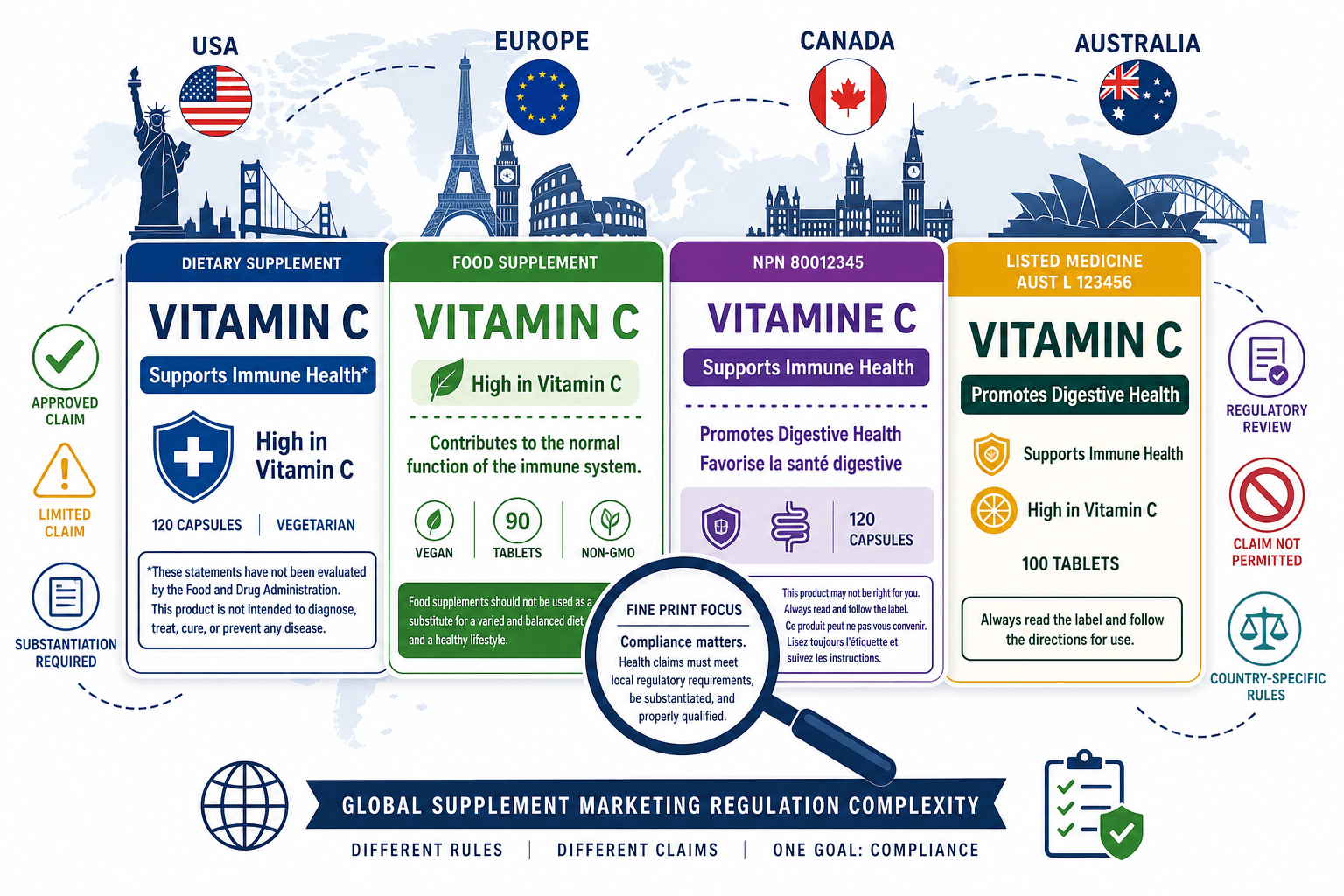
A supplement label that is fully compliant in the United States may require significant changes before it can legally appear on shelves in Germany, France, Canada, or Australia. A claim as simple as "supports immune health" may be acceptable under one regulatory framework and prohibited under another. Even when the wording seems similar, regulators often define, evaluate, and approve claims differently.

This challenge has become even more relevant as regulators continue increasing scrutiny of supplement marketing. FDA warning letters repeatedly highlight unsupported disease claims and misleading labeling, while European authorities maintain strict control over which health claims may be used. Regulatory expectations also evolve over time—for example, FDA clarified its position on the placement of the mandatory DSHEA disclaimer in late 2025, demonstrating that compliance is not a static exercise.

For nutrition and supplement brands, successful global expansion isn't about translating labels. It's about rebuilding label claims to fit a different legal framework while maintaining brand consistency across every market.

Why Label Claims Become the Biggest Compliance Risk

Marketing teams naturally want consistent messaging worldwide. Consumers should recognize the same product regardless of where it's sold.

Regulators, however, don't evaluate labels through a branding lens—they evaluate them through local legislation.

As brands expand internationally, the same artwork often goes through multiple revisions involving marketing, regulatory affairs, legal teams, local distributors, translators, and packaging agencies. Every additional reviewer increases the risk that:

  • approved wording is modified late in the process;
  • translations lose their legal meaning;
  • local teams introduce claims that were never reviewed by regulatory specialists;
  • the final production artwork differs from the legally approved version.

In many organizations, the breakdown doesn't happen because teams don't understand the regulations—it happens because the approval process cannot reliably control changes across multiple markets.

United States: FDA and DSHEA Focus on Structure/Function Claims

In the U.S., dietary supplements are primarily regulated under the Dietary Supplement Health and Education Act (DSHEA).

One of the key distinctions is between structure/function claims and disease claims.

Statements such as:

  • "Supports immune health"
  • "Helps maintain healthy joints"
  • "Promotes digestive health"

may qualify as structure/function claims when they comply with FDA requirements and do not imply diagnosis, treatment, cure, or prevention of disease.

When using structure/function claims, manufacturers must also include the required DSHEA disclaimer:

"These statements have not been evaluated by the Food and Drug Administration. This product is not intended to diagnose, treat, cure, or prevent any disease."

Manufacturers are generally required to notify FDA within 30 days after first marketing a product bearing a structure/function claim.

Importantly, FDA expectations continue to evolve. In December 2025, FDA clarified that the DSHEA disclaimer does not necessarily need to appear on every label panel, provided it is clearly linked to the applicable structure/function claim. While this offers additional flexibility for label design, it also reinforces why regulatory teams must continuously monitor changing guidance rather than relying on outdated templates.

Because FDA guidance evolves, brands should regularly review current requirements and consult regulatory counsel before launching products in the U.S.

European Union: Only Approved Health Claims Are Allowed

The European approach is fundamentally different.

Under Regulation (EC) No. 1924/2006, nutrition claims and health claims are treated separately.

Nutrition claims describe the nutritional characteristics of a product, such as:

  • "High in vitamin C"
  • "Low sugar"

Health claims, however, describe a relationship between a food or nutrient and health.

Unlike the U.S. system, companies cannot simply create their own compliant wording. Health claims generally must appear on the EU Register of authorised claims following scientific evaluation by the European Food Safety Authority (EFSA).

This creates a standardized framework across all 27 EU member states:

  • only authorized health claims may be used;
  • wording must remain consistent with approved claims;
  • scientific substantiation has already been evaluated at EU level.

Although the approved claims are harmonized across the EU, packaging is not. Labels must still comply with language requirements in every country where the product is sold, meaning a single SKU often requires multiple localized versions.

For brands entering Europe, compliance is therefore both a legal and operational challenge.

UK, Canada, and Australia: Similar Goals, Different Systems

Outside the EU, regulatory models differ again.

United Kingdom

Following Brexit, many nutrition and health claim rules remain closely aligned with former EU legislation, but companies should verify current UK-specific requirements before launch, particularly as regulations continue to evolve independently.

Canada

Canada regulates supplements as Natural Health Products (NHPs).

Unlike the U.S., products generally require pre-market authorization before being sold. Companies must obtain the appropriate product licence, supported by evidence demonstrating safety, efficacy, and quality. Label claims are reviewed as part of this process.

Australia

Australia regulates many complementary medicines through the Therapeutic Goods Administration (TGA).

Depending on product classification, products may need to be listed or registered in the Australian Register of Therapeutic Goods. Permitted ingredients, evidence requirements, and acceptable daily dosages can differ significantly from other jurisdictions.

The practical result is straightforward:

The same ingredient, formulation, or marketing claim may be perfectly acceptable in one country while requiring different evidence—or being prohibited altogether—in another.

Where Multi-Market Compliance Usually Breaks Down

Most compliance issues don't originate from misunderstanding regulations.

They emerge during collaboration.

A common scenario looks like this:

Marketing prepares a global label.

Regulatory approves the U.S. version.

Localization teams adapt the copy for Europe.

A distributor requests wording changes for Canada.

Packaging updates artwork shortly before production.

Legal reviews an earlier PDF—not the final print-ready file.

Everything appears approved until someone notices the finished label contains a claim that no regulatory reviewer actually signed off on.

This becomes even more complicated when translations subtly change legal meaning. A direct translation may preserve marketing intent while unintentionally creating an unauthorized health claim under local legislation.

The challenge is no longer legal interpretation.

It's version control.

Compliance Depends on Process as Much as Regulation

Understanding regulations is only half the solution.

The other half is ensuring every approved claim survives the approval process unchanged until production.

Leading nutrition brands increasingly build structured approval workflows around regulatory governance rather than relying solely on email reviews and manual PDF markups.

An effective multi-market approval process typically includes:

  • market-specific artwork versions linked to each SKU;
  • mandatory regulatory sign-off as an independent approval role;
  • separate approval paths for marketing, legal, and regulatory teams;
  • centralized storage of approved claims by jurisdiction;
  • complete audit history showing who approved each revision and when;
  • comments attached directly to the affected claim on the artwork rather than scattered across email threads.

This creates a single source of truth for compliance while reducing the risk of unauthorized last-minute edits.

For organizations managing multiple markets simultaneously, this level of process control often delivers more value than adding another legal review.

Checklist Before Launching a Supplement in a New Market

Before approving production artwork, verify that your team has completed the following:

  • □ Confirm every label claim is permitted in the target jurisdiction.
  • □ Verify required disclaimers and mandatory statements appear correctly.
  • □ Ensure translations preserve the legal meaning—not just the marketing message.
  • □ Confirm ingredient levels and formulations meet local regulatory requirements.
  • □ Require regulatory affairs approval on the final production-ready artwork—not an earlier draft.
  • □ Maintain version control separately for each market and SKU.
  • □ Archive an auditable approval history for future inspections and internal governance.

Final Thoughts

Global expansion doesn't fail because brands lack strong products.

It fails when a compliant label in one market is assumed to be compliant everywhere else.

As regulatory frameworks continue evolving across the U.S., EU, UK, Canada, and Australia, supplement companies need more than legal expertise. They need approval processes capable of controlling every change made to artwork before products reach the market.

For regulatory affairs, marketing, and packaging teams, compliance is no longer just about understanding the law—it's about ensuring the right people approve the right version at the right time.


Ready to Strengthen Your Approval Process?

If your team manages supplement packaging across multiple markets, regulatory approval should be built into your workflow—not handled through email chains and manual file reviews.

Learn how Cway helps nutrition and supplement brands implement mandatory regulatory sign-offs, maintain market-specific artwork versions, centralize approved claims, and keep a complete audit trail for every packaging approval decision.


How FMCG packaging claims get approved and audited

1 min read

How FMCG packaging claims get approved and audited

Every packaging claim on your label—"100% recyclable," "high in fiber," "clinically proven"—carries regulatory weight. Before it reaches the shelf,...

View Full Article
8 Best Packaging Annotation Tools for Label Reviews in 2026

1 min read

8 Best Packaging Annotation Tools for Label Reviews in 2026

Reviewing packaging labels across multiple markets is complex work. Regulatory requirements differ, languages multiply, and even a small annotation...

View Full Article
How to build a compliant and scalable approval workflow

1 min read

How to build a compliant and scalable approval workflow

Creating packaging isn’t just about great design—it’s about building an approval workflow that ensures every step, from concept to shelf, is aligned,...

View Full Article