
 Ekaterina Skalatskaia
EU compliance controls: which artwork platform leads?
 Ekaterina Skalatskaia : July 9, 2026 at 9:14 AM
Evaluating artwork management platforms for EU compliance? Compare audit trails, compliance gates, and traceability controls.
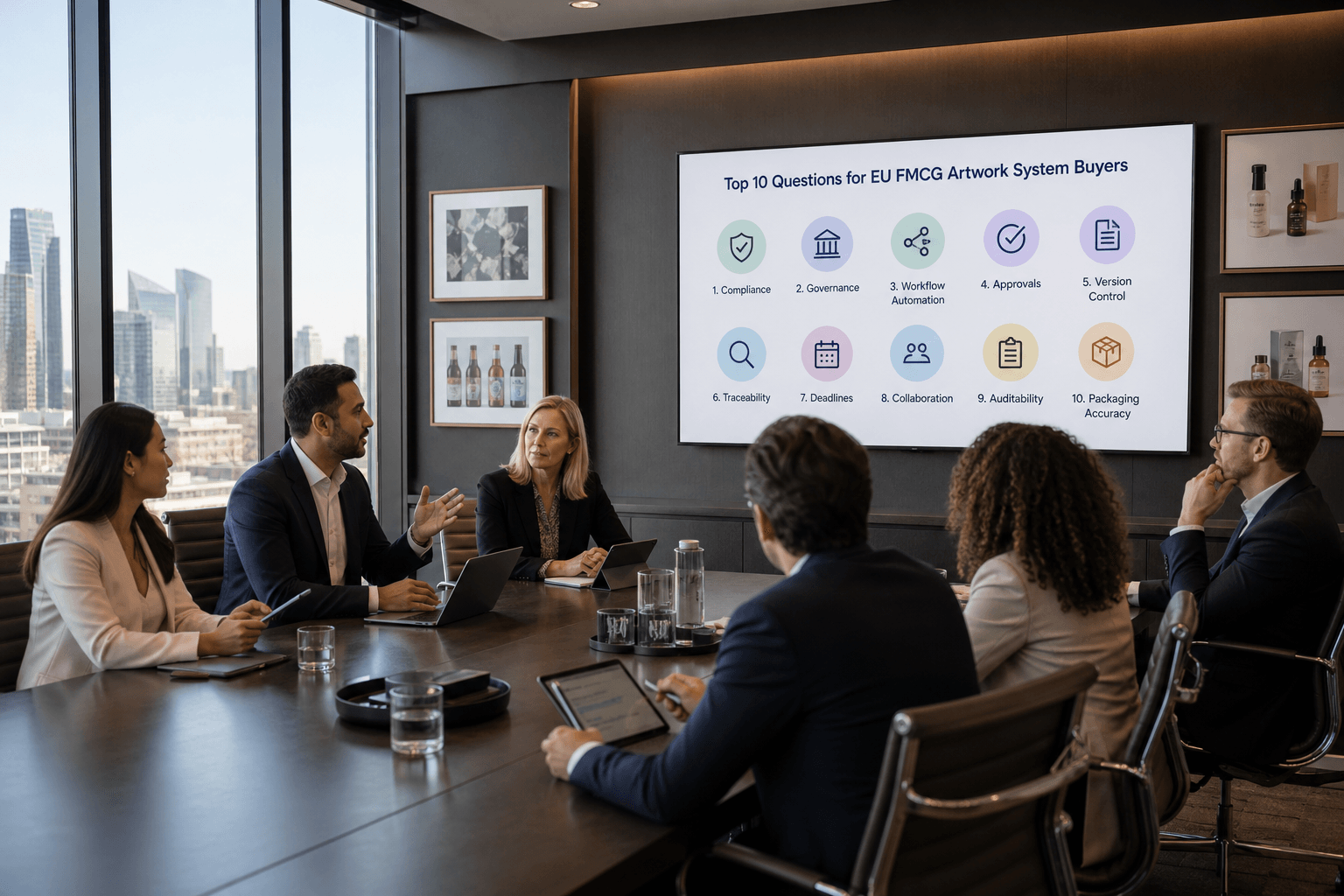
Buying artwork software for an FMCG business in Europe is not the same as buying a generic proofing tool. You’re dealing with many markets and languages, strict labeling rules, fast product changes, and a long list of stakeholders: brand, regulatory, quality, packaging development, agencies and printers.
Vendor demos tend to look alike, so the questions you ask matter more than the features they show. Here are ten that separate a good fit from an expensive mistake.
Why it matters: An approval step is only one moment in an artwork’s life. Before it comes briefing and creation. After it come release to print, archiving, and the revisions that follow every recipe, regulatory or design change.
What good looks like: Artwork Lifecycle Management (ALM). Every artwork has one record that holds its full history from brief to archive and back into revision.
Red flag: The tool is a proofing viewer bolted onto a file share, and history disappears once a job is closed.
Why it matters: A single EU SKU can carry five or more languages, or exist in separate country variants. Each variant needs the right reviewers, and one change to the master often has to flow into all of them.
What good looks like: You can structure artwork by market, language and variant, and send each one to the right local reviewers.
Red flag: Every variant is handled as an unrelated file, so a change to one has to be reproduced by hand in every other.
Why it matters: Allergen emphasis under EU FIC (Regulation 1169/2011), nutrition and health claims, and PPWR labeling requirements all need expert judgement. No software can guarantee that a label is legally compliant, and a vendor that suggests otherwise is selling risk.
What good looks like: The system enforces the process around regulatory review. Mandatory approvers can’t be skipped, final release is blocked until every required sign-off is in, and rejection reasons are logged. Any automated or AI checks are presented as aids for reviewers, not as verdicts.
Red flag: Claims like “automatic compliance” or “PPWR-ready artwork” with no explanation of who makes the actual decision.
Ask the vendor: “What exactly does your system check, and what does it leave to our people?”
Why it matters: When a retailer, authority or internal auditor asks who approved a label, the answer has to be immediate and complete.
What good looks like: Every comment, revision, approval and rejection is recorded permanently, tied to a named person and to the exact revision it applies to. Nothing can be overwritten.
Red flag: Approvals are stored as a status field, with no record of who decided, or on which version.
Ask the vendor: “Show me the complete history of one artwork, live, right now.”
Why it matters: Most costly packaging errors trace back to the wrong version: an outdated allergen statement, an old barcode, a claim that was supposed to be removed.
What good looks like: Every revision is kept. Reviewers compare versions side by side or as an overlay, so they see exactly what changed instead of re-reading the whole pack.
Red flag: Versioning means “upload a new file with a new name.”
Why it matters: In FMCG, brand, regulatory, quality and marketing all review the same pack, and they don’t always agree. If every comment goes straight to the designer, you get conflicting revisions and extra rounds.
What good looks like:
Red flag: A strictly sequential approval chain, where every change restarts the full round.
Why it matters: External partners create the files and put them on press. If they work outside the system, the source of truth breaks exactly where errors are most expensive.
What good looks like: Agencies and printers get controlled access, see only their own projects, upload revisions without email attachments, and always get the latest approved file. You can see when the printer has actually received it.
Red flag: External partners need full paid licenses, or files still travel to them by email.
Why it matters: Unreleased artwork, launch plans and recipes are commercially sensitive. EU businesses also need a clear GDPR position for every user, internal and external.
What good looks like: Clear answers on hosting, encryption, backups, access control, single sign-on and data processing agreements, plus a clear exit path for your files and history.
Red flag: Vague answers about where data lives, or no clear way to take your data with you.
Why it matters: The real competitor for any artwork system is “doing nothing”: email and spreadsheets. If brand managers and regulatory reviewers find the tool harder than email, they’ll go back to email.
What good looks like: Reviewers work in the browser, with no design software and little or no training. Suppliers can join without creating accounts, and rollout can grow category by category.
Red flag: Reviewers need desktop software or long training, or the interface is built only for power users.
Why it matters: A supplier change, a new allergen rule or a PPWR labeling update can touch hundreds of SKUs. If you can’t see which artwork is affected, you’re guessing.
What good looks like: Artwork is linked to product data such as GTIN, the library is searchable, and you can start controlled revisions from the current approved versions, in bulk.
Red flag: Impact analysis means someone exporting lists and checking them by hand.
| # | Question |
Vendor A | Vendor B | Vendor C |
|---|---|---|---|---|
| 1 | Full lifecycle (ALM), not just approval | |||
| 2 | Multilingual text checks, linked to product | |||
| 3 | Clear split between system checks and human decisions | |||
| 4 | Permanent, revision-level audit trail | |||
| 5 | Version comparison side by side and overlay | |||
| 6 | Parallel review, one decision-maker, selective re-approval | |||
| 7 | External partners without paid licenses | |||
| 8 | Clear hosting, security and GDPR position | |||
| 9 | Browser-based, low-friction adoption | |||
| 10 | Find all artwork affected by a change |
Cway is an Artwork Lifecycle Management (ALM) platform for packaging teams, developed by Cway AB in Gothenburg, Sweden.
| # | How Cway does it |
|---|---|
| 1 | Brief to archive in one platform. Approved masters are filed automatically, and retired artwork is marked obsolete instead of deleted, keeping its full history. |
| 2 | AI text extraction with packaging-specific spell-check across every language on the pack, translation of text blocks, and flags for outdated translations. |
| 3 | Cway runs the process, your experts make the decisions. Final release is blocked until all mandatory approvals are in, and rejection reasons are logged. Plain-language rules are checked by AI as suggestions for reviewers to verify. |
| 4 | Every action is a permanent event, and every approval is tied to the exact revision it was given on. |
| 5 | Side-by-side, overlay, blinking and red-mode comparison, across revisions, projects and library files. |
| 6 | Parallel approvals by default, orderer-led decisions, selective re-approval and team approvals. |
| 7 | Suppliers, agencies and printers join for free, work through secure links without a login, and artwork is marked Delivered only when the printer has downloaded it. |
| 8 | Hosted on AWS with encryption in transit and at rest, geo-redundant storage, Azure AD single sign-on and GDPR-aligned data handling. |
| 9 | Browser-based Viewer with no design software needed, and no accounts for external suppliers. |
| 10 | Artwork linked to products by GTIN, barcodes detected automatically and searchable, and bulk actions for hundreds of SKUs at once. |
Bring these ten questions to a Cway demo, and we’ll answer them live, using your own workflow.

 Ekaterina Skalatskaia : July 9, 2026 at 9:14 AM
Evaluating artwork management platforms for EU compliance? Compare audit trails, compliance gates, and traceability controls.

 William Janeway : July 6, 2026 at 10:30 AM
Compare the top 8 packaging artwork control systems for FMCG brands. Find tools for approvals and cross-market collaboration with Cway and more.
 William Janeway : March 17, 2026 at 4:40 AM
Compare label and artwork management software for packaging teams. Discover Cway Software and solutions for approvals, compliance, and workflow...